
We synthesize PNA to your sequence, unlabeled or labeled at either terminus with FAM, FITC, biotin, or a Cy dye, plus any modification your assay needs.
PNA's neutral backbone binds complementary DNA and RNA more tightly than DNA does, with sharper mismatch discrimination, so probes work at low concentration and low background.
Beyond plain oligos, we make PNA-FISH probes, PCR clamps for mutation detection, and peptide-conjugated PNA that enters cells without a transfection reagent.
A peptide nucleic acid is a synthetic mimic of DNA or RNA. The bases are the same, but they sit on a neutral peptide-like backbone instead of the sugar-phosphate backbone of natural nucleic acids. That backbone is what gives PNA its strong, specific binding and its stability.
DNA has a negatively charged sugar-phosphate backbone; PNA has an uncharged polyamide backbone. Because there is no charge repulsion, PNA binds complementary DNA or RNA more tightly and with better mismatch discrimination, hybridizes well at low salt, and resists nucleases and proteases.
PNA is used for molecular diagnostics and gene research, including PNA-FISH, PCR clamping for mutation detection, antisense and antigene studies, miRNA inhibition, SNP detection, biosensors, and microarrays.
Yes. We make fluorescently labeled PNA, including FAM, FITC, and Cy dyes, and PNA-FISH probes that hybridize quickly and specifically with low background. Labels can go on one or both termini.
A PNA clamp is a sequence that binds a wild-type DNA sequence and blocks its amplification in PCR, so a rare mutant sequence is amplified instead. It is widely used to detect low-frequency mutations against a large wild-type background.
Yes. We conjugate PNA to cell-penetrating peptides so it can enter cells without a transfection reagent, which is useful for antisense and miRNA-inhibition work. We also add biotin, PEG, and other groups on request.
A peptide nucleic acid (PNA) is a synthetic analog of DNA and RNA. It carries the same four bases, so it reads and pairs with nucleic acids the same way, but its backbone is built differently. That single change gives PNA a set of properties that natural oligonucleotides cannot match, and it is why PNA has become a go-to reagent in molecular diagnostics and gene research.
Natural nucleic acids are held together by a sugar-phosphate backbone joined through phosphodiester bonds, and they do not contain peptide bonds. PNA replaces that backbone with repeating N-(2-aminoethyl)glycine units linked by amide bonds, the same kind of bond found in peptides, which is where the name comes from. The bases hang off this neutral backbone and pair with DNA or RNA in the usual way.
The backbone has no phosphate charge, so when PNA meets a complementary DNA or RNA strand there is no electrostatic repulsion to overcome. The result is tighter binding, a higher melting temperature, and sharper discrimination against single-base mismatches than DNA gives. PNA also hybridizes well at low salt, and because no natural enzyme recognizes its backbone, it resists nucleases and proteases and stays intact in biological samples.
These properties open up several uses:
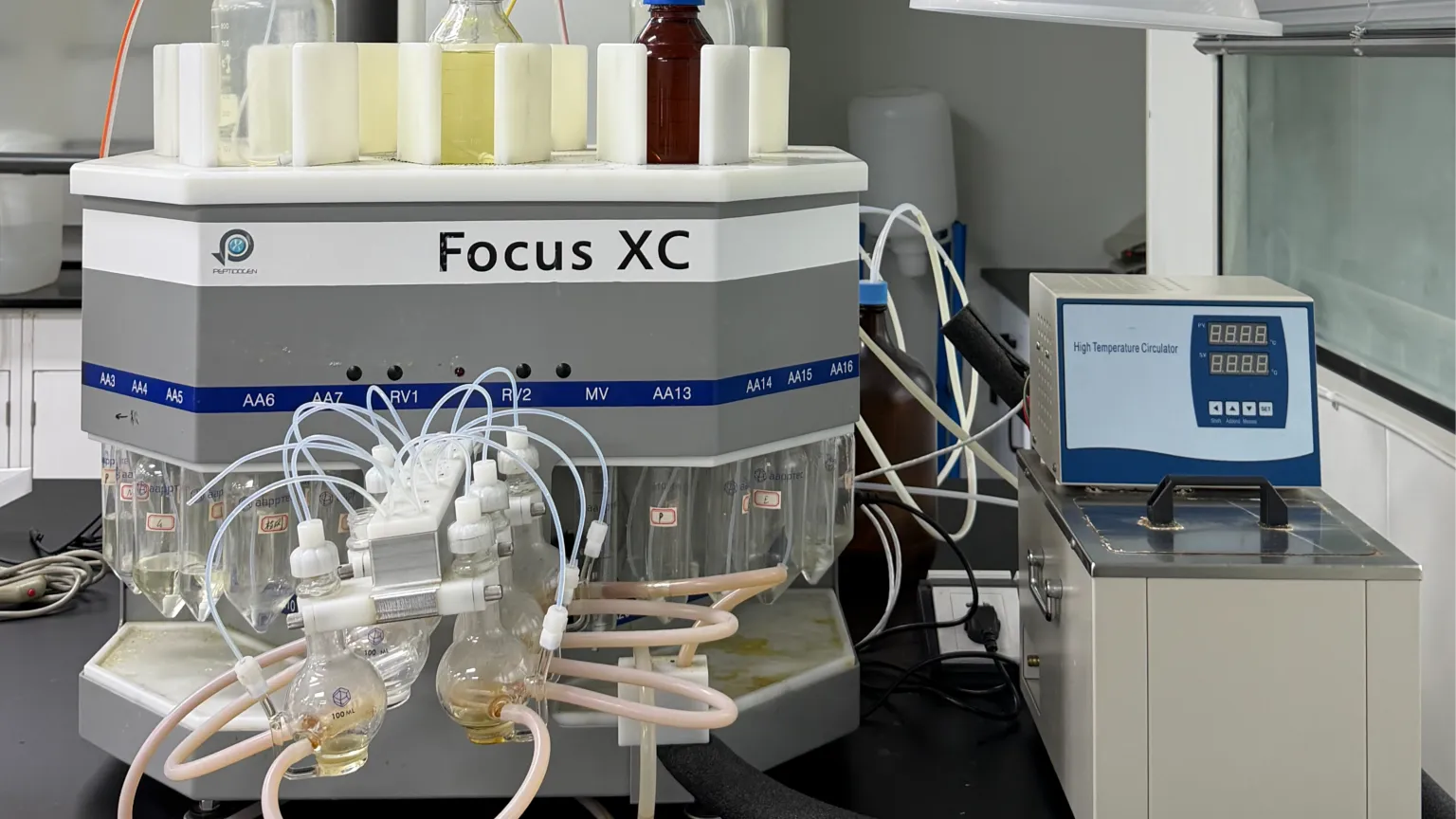
PNA is built by solid-phase synthesis from protected PNA monomers, the same chemistry used to make peptides, which is why we can produce it to your exact sequence. We supply unlabeled and labeled PNA oligos, PNA-FISH probes, PCR clamps, biotinylated PNA, and peptide-conjugated PNA, with labels at one or both termini. For related work, see custom peptide synthesis and peptide modification.
Peptide nucleic acids are supplied for laboratory research use.


