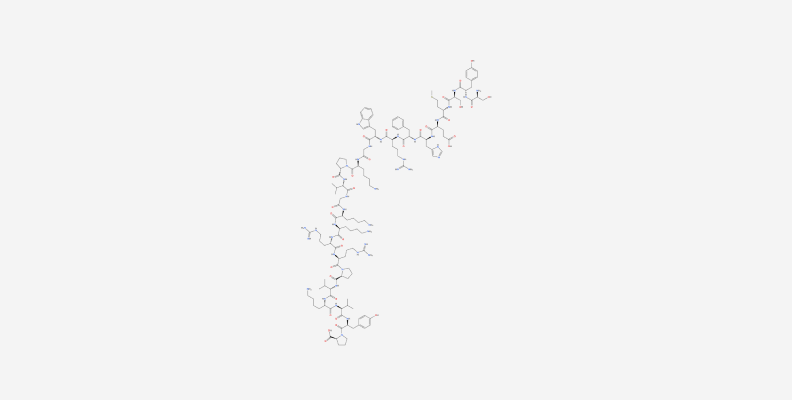
| Product Name | ACTH (1-24) |
| Synonyms | Tetracosactide, Cosyntropin, Tetracosactrin, Synacthen, Cortrosyn |
| CAS Number | 16960-16-0 |
| Sequence (3-Letter) | H-Ser-Tyr-Ser-Met-Glu-His-Phe-Arg-Trp-Gly-Lys-Pro-Val-Gly-Lys-Lys-Arg-Arg-Pro-Val-Lys-Val-Tyr-Pro-OH |
| Sequence (1-Letter) | SYSMEHFRWGKPVGKKRRPVKVYP (24 residues) |
| Molecular Formula | C₁₃₆H₂₁₀N₄₀O₃₁S |
| Molecular Weight | 2933.4 |
| Category | Drug Peptide – ACTH Analog (MC2 Receptor Agonist) |
| Purity | ≥98% (by HPLC) |
| Appearance | White to off-white lyophilized powder |
| Counter Ion | Acetate (salt form per specification) |
| Peptide Content | ≥80% (per specification) |
| Solubility | Soluble in water |
| Storage | -20°C, desiccated, protected from light |
| Available Scale | mg – kg (research quantities to scale-up batches) |
| QC Documentation | COA, HPLC, MS identity (additional API/regulatory documentation on request) |
| Usage | For research and pharmaceutical development use, and as a reference standard or active pharmaceutical ingredient for manufacturing. Not for human or veterinary use; not for sale to patients. Any therapeutic use is subject to applicable regulatory approval. |
ACTH (1-24) is a synthetic peptide made of the first twenty-four amino acids of the hormone ACTH (adrenocorticotropic hormone), also known as tetracosactide or cosyntropin (CAS 16960-16-0). Its sequence is SYSMEHFRWGKPVGKKRRPVKVYP. This short part of ACTH keeps the full hormone-stimulating activity but is less likely to cause an allergic reaction than the whole hormone. We supply it as a white powder for research and pharmaceutical development.
ACTH (1-24) acts on the adrenal glands in the same way as natural ACTH. It binds the ACTH receptor (the melanocortin type-two receptor) on the adrenal cortex and signals it to make and release corticosteroids such as cortisol. The activity of ACTH lives in this N-terminal part of the molecule, which is why the short peptide works as well as the full hormone.
ACTH (1-24) is used mainly as a diagnostic agent in the ACTH stimulation test, which checks how well the adrenal glands respond by measuring cortisol after a dose. It is also used in some inflammatory conditions as an alternative to ACTH. This is background information only; the material we supply is for research and pharmaceutical manufacturing use, and is not for human or veterinary use and not for sale to patients.
We supply ACTH (1-24) with a certificate of analysis, HPLC purity data, and mass-spec identity confirmation. Additional documentation for API and regulatory work is available on request, and purity can be set to your specification.
Yes. We manufacture ACTH (1-24) in-house and supply from research quantities up to scale-up batches. Contact us with your required purity, salt form, and quantity for a quote.
ACTH (1-24) is a synthetic peptide corresponding to the first twenty-four amino acids of adrenocorticotropic hormone (ACTH). It is also known as tetracosactide or cosyntropin and is used mainly as a diagnostic agent for adrenal function. We supply it as a raw material for research and pharmaceutical development.
ACTH (1-24) is a twenty-four-residue peptide, SYSMEHFRWGKPVGKKRRPVKVYP, identical to the N-terminal part of the full ACTH hormone. It is a native sequence with no chemical modifications, no D-amino acids, and no disulfide bonds. Because the biological activity of ACTH resides in this N-terminal region, the short peptide retains the full hormone-stimulating activity while being less immunogenic than the whole hormone. Its CAS number is 16960-16-0, its molecular formula is C136H210N40O31S, and its molecular weight is about 2933.
ACTH (1-24) acts on the adrenal cortex just as natural ACTH does. It binds the ACTH receptor, the melanocortin type-two receptor, and signals the adrenal cortex to produce and release corticosteroids such as cortisol. Giving the peptide therefore raises circulating glucocorticoid levels, which is the basis of its use to probe adrenal function.
ACTH (1-24) is used mainly as a diagnostic agent in the ACTH stimulation test, where the cortisol response after a dose is measured to assess adrenal insufficiency, and it is also used in some inflammatory and autoimmune conditions as an alternative to ACTH. This information is provided as scientific and reference background only. The material supplied by SynPeptide is intended for research and pharmaceutical manufacturing, is not for human or veterinary use, and is not for sale to patients; any diagnostic or therapeutic use is subject to applicable regulatory approval.
We supply ACTH (1-24) with a certificate of analysis, HPLC purity data, and mass-spectrometry identity confirmation, with further documentation available to support active pharmaceutical ingredient and regulatory work. Purity and counter-ion can be set to your specification for use as a reference standard or in process development.
We manufacture ACTH (1-24) by solid-phase synthesis and supply it from research quantities through to scale-up batches. For related capabilities, see drug peptides, custom peptide synthesis, large-scale peptide synthesis, and our peptide CDMO services. Material is supplied for research and pharmaceutical manufacturing use only.


