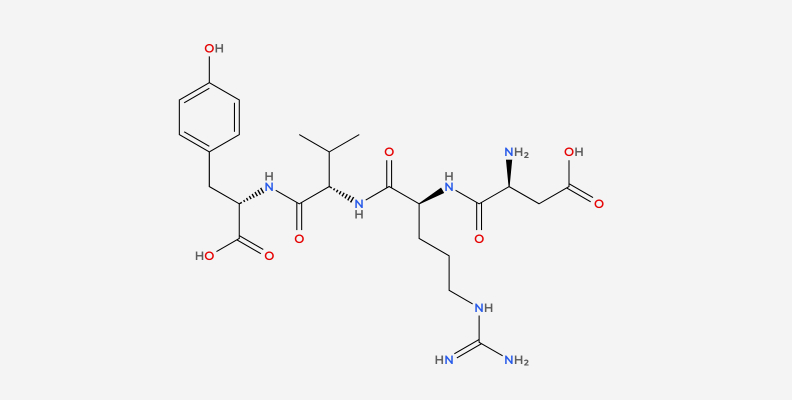
| Product Name | Angiotensin II (1-4), human |
| Synonyms | Ang II (1-4); Angiotensin (1-4); DRVY; H-Asp-Arg-Val-Tyr-OH; Angiotensinogen (34-37) |
| CAS Number | 52580-29-7 |
| Sequence (3-Letter) | H-Asp-Arg-Val-Tyr-OH |
| Sequence (1-Letter) | DRVY-OH (4 residues; free acid C-terminus) |
| Molecular Formula | C₂₄H₃₇N₇O₈ |
| Molecular Weight | 551.6 |
| Category | Drug Peptide – angiotensin / renin-angiotensin system (RAS) fragment |
| Purity | ≥95% (by HPLC); higher purity available on request |
| Appearance | White to off-white lyophilized powder |
| Counter Ion | Trifluoroacetate (TFA) by default; TFA-removed or acetate on request |
| Peptide Content | ≥80% (per specification) |
| Solubility | Soluble in water (about 2 mg/mL); acetonitrile or dilute acid aids higher concentrations |
| Storage | -20°C, desiccated, protected from light (hygroscopic); aliquot to limit freeze–thaw |
| Available Scale | mg – g (research quantities; larger scale on enquiry) |
| QC Documentation | COA, HPLC, MS identity (additional documentation on request) |
| Usage | For research use and pharmaceutical or analytical development only. Not for human or veterinary use; not for sale to patients. |
Angiotensin II (1-4), also written Ang II (1-4) or DRVY, is the four-residue N-terminal fragment of angiotensin II. Its sequence is H-Asp-Arg-Val-Tyr-OH with a free acid C-terminus, and it carries CAS 52580-29-7 and the molecular formula C24H37N7O8. It is an endogenous fragment of the renin-angiotensin system, and we supply it as a synthetic lyophilized powder for research use.
Angiotensin II (1-4) is a downstream breakdown product within the renin-angiotensin system. Full-length angiotensin II is processed by peptidases such as angiotensin-converting enzyme and aminopeptidases into a series of shorter fragments, and the (1-4) tetrapeptide is one of these metabolites. Because it has lost the C-terminal residues that drive angiotensin II receptor binding, it does not carry the vasoconstrictor activity of the parent hormone and is studied mainly as a metabolite and reference peptide.
Researchers use Angiotensin II (1-4) as a reference standard and marker for studying angiotensin peptide metabolism in the renin-angiotensin system. Typical work includes mapping how angiotensin-converting enzyme and aminopeptidases cleave angiotensin peptides, and using the fragment as a calibration or identity standard in mass-spec and chromatography assays. The material we supply is for research and analytical use, is not for human or veterinary use, is not for sale to patients, and we make no health or therapeutic claims.
We supply Angiotensin II (1-4) at high HPLC purity with a certificate of analysis, an HPLC chromatogram, and mass-spec identity confirmation. It ships as the trifluoroacetate salt by default, with a TFA-removed or acetate option on request, and purity, salt form, and quantity can be set to your specification.
Yes. We synthesise Angiotensin II (1-4) in-house and supply from milligram research amounts up to larger batches. We also prepare related angiotensin fragments and modified versions to order, such as isotope-labelled or fluorescent forms for assay development. Send us your required purity, salt form, quantity, and any modification, and we will quote it.
Angiotensin II (1-4), or Ang II (1-4), is the four-residue N-terminal fragment of angiotensin II and an endogenous peptide of the renin-angiotensin system (RAS). It is the tetrapeptide H-Asp-Arg-Val-Tyr-OH (DRVY), produced when angiotensin peptides are trimmed by peptidases in the RAS cascade. We make it as a synthetic research-grade peptide and supply it as a raw material for laboratory and analytical work.
The peptide has the sequence H-Asp-Arg-Val-Tyr-OH (one-letter DRVY), the first four residues of the angiotensin II octapeptide, supplied with a free acid C-terminus. Its CAS number is 52580-29-7, its molecular formula is C24H37N7O8, and its molecular weight is about 551.6. It maps to residues 34–37 of angiotensinogen. It is usually supplied as the trifluoroacetate salt, with a TFA-removed or acetate form available on request.
The renin-angiotensin system generates a family of angiotensin peptides from angiotensinogen. Renin releases angiotensin I, angiotensin-converting enzyme (ACE) forms the active hormone angiotensin II (1-8), and ACE2 and other peptidases then process these into shorter fragments such as angiotensin (1-7), angiotensin (1-5), and angiotensin (1-4). The (1-4) tetrapeptide is one of these short metabolites. Because it has lost the C-terminal residues that angiotensin II uses to bind its receptors, it does not share the strong vasoconstrictor activity of full-length angiotensin II and is handled as a metabolic fragment rather than an active effector.
Angiotensin II (1-4) is used in research on angiotensin peptide metabolism and the wider renin-angiotensin system. Common uses include studying how ACE, ACE2, and aminopeptidases cleave angiotensin peptides, and serving as a reference or calibration standard for identifying and quantifying angiotensin fragments by LC-MS/MS and HPLC. It is also used as a control alongside longer angiotensin peptides such as angiotensin I, angiotensin II, and angiotensin (1-7). All of this is research context only: the material we supply is for research and pharmaceutical or analytical development, is not for human or veterinary use, is not for sale to patients, and we make no health, diagnostic, or therapeutic claims.
The lyophilized peptide is hygroscopic and should be stored at -20°C, kept dry and protected from light. It dissolves in water at around 2 mg/mL; for higher concentrations a little acetonitrile or dilute acid helps, and the short sequence with an acidic aspartate and a basic arginine makes it generally straightforward to work with. Aliquot stock solutions to avoid repeated freeze-thaw, and where a cell-based or sensitive assay is planned, specify a TFA-removed or acetate salt so residual trifluoroacetate does not interfere.
We supply the full angiotensin series for comparative and pathway work, including angiotensin I, angiotensin II (1-8), angiotensin (1-7), angiotensin (1-5), and other fragments and analogues. Sequence-defined variants, isotope-labelled internal standards, and fluorescent or biotin labelling are handled through our peptide modification service, and the wider angiotensin and bioactive range sits under our drug peptides. Ordering a fragment and its parent peptide from the same batch keeps purity, salt form, and counter-ion consistent across an experiment.
We make Angiotensin II (1-4) by solid-phase synthesis and release it with a certificate of analysis, HPLC purity data, and mass-spectrometry identity confirmation, with purity and salt form set to your specification. Supply runs from milligram research quantities through to larger batches, and sequence-defined or modified analogues are available through custom peptide synthesis, with gram-and-above orders handled by our large-scale peptide synthesis platform. Material is supplied for research and pharmaceutical development use only.


