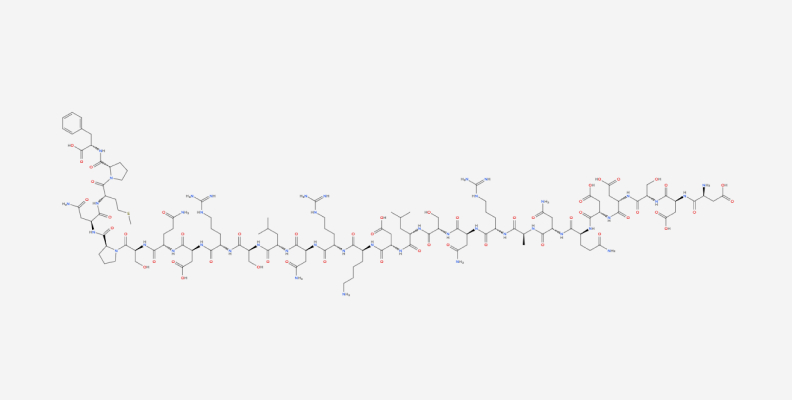
| Product Name | Apelin-36, human |
| Synonyms | Apelin-36 (human); Apelin 36; APJ receptor agonist; Apelin (42-77) |
| CAS Number | 252642-12-9 |
| Sequence (3-Letter) | H-Leu-Val-Gln-Pro-Arg-Gly-Ser-Arg-Asn-Gly-Pro-Gly-Pro-Trp-Gln-Gly-Gly-Arg-Arg-Lys-Phe-Arg-Arg-Gln-Arg-Pro-Arg-Leu-Ser-His-Lys-Gly-Pro-Met-Pro-Phe-OH |
| Sequence (1-Letter) | LVQPRGSRNGPGPWQGGRRKFRRQRPRLSHKGPMPF (36 residues; free acid C-terminus) |
| Molecular Formula | C₁₈₄H₂₉₇N₆₉O₄₃S |
| Molecular Weight | 4195.9 |
| Category | Drug Peptide – apelin / APJ (apelin receptor) agonist |
| Purity | ≥95% (by HPLC); higher purity available on request |
| Appearance | White to off-white lyophilized powder |
| Counter Ion | Trifluoroacetate (TFA) by default; TFA-removed or acetate on request |
| Peptide Content | ≥80% (per specification) |
| Solubility | Soluble in water; reconstitute in dilute aqueous buffer for stock solutions |
| Storage | -20°C, desiccated, protected from light; aliquot to limit freeze–thaw |
| Available Scale | mg – g (research quantities; larger scale on enquiry) |
| QC Documentation | COA, HPLC, MS identity (additional documentation on request) |
| Usage | For research use and pharmaceutical or analytical development only. Not for human or veterinary use; not for sale to patients. |
Apelin-36 is the longest natural form of apelin, a thirty-six-residue peptide and the endogenous ligand for the apelin receptor (APJ). Its one-letter sequence is LVQPRGSRNGPGPWQGGRRKFRRQRPRLSHKGPMPF, with a free acid C-terminus, and it carries CAS 252642-12-9 and the molecular formula C184H297N69O43S. We make it in-house and supply it as a lyophilized powder for research use.
Apelin-36 works by binding and activating the apelin receptor (APJ), a G-protein-coupled receptor, with nanomolar affinity at the human receptor. Acting through this receptor it influences cardiovascular and metabolic signalling in research models. The shorter natural forms, apelin-seventeen and apelin-thirteen, share the conserved C-terminal end of apelin-36, which is the part the receptor recognises.
Apelin-36 is studied in research on the apelin-APJ system, mainly in cardiovascular and metabolic biology, including heart function, fluid balance, and energy and glucose regulation. It has also been used in research showing that apelin peptides block entry of some HIV strains into cells that express the APJ co-receptor. These are research findings only; the material we supply is for research and pharmaceutical use, is not for human or veterinary use, is not for sale to patients, and we make no health or therapeutic claims.
We supply Apelin-36 at high HPLC purity with a certificate of analysis, an HPLC chromatogram, and mass-spec identity confirmation. It ships as the trifluoroacetate salt by default, with a TFA-removed or acetate option on request, and purity, salt form, and quantity can be set to your specification.
Yes. We synthesise Apelin-36 in-house and supply from milligram research amounts up to larger batches. We also prepare related apelin forms and modified versions to order, such as shorter apelin fragments, PEGylated or labelled analogues, and sequence variants for structure-activity work. Send us your required purity, salt form, quantity, and any modification, and we will quote it.
Apelin-36 is the longest natural form of apelin and the endogenous ligand for the apelin receptor (APJ, also called APLNR). It is a 36-residue peptide central to research on the apelin-APJ system in cardiovascular and metabolic biology. We make it as a synthetic research-grade peptide and supply it as a raw material for laboratory and pharmaceutical development work.
Apelin-36 has the sequence H-Leu-Val-Gln-Pro-Arg-Gly-Ser-Arg-Asn-Gly-Pro-Gly-Pro-Trp-Gln-Gly-Gly-Arg-Arg-Lys-Phe-Arg-Arg-Gln-Arg-Pro-Arg-Leu-Ser-His-Lys-Gly-Pro-Met-Pro-Phe-OH (one-letter LVQPRGSRNGPGPWQGGRRKFRRQRPRLSHKGPMPF), supplied with a free acid C-terminus. Its CAS number is 252642-12-9, its molecular formula is C184H297N69O43S, and its molecular weight is about 4195.9. It is the mature 36-residue form of apelin, processed from a larger apelin precursor and corresponding to residues 42–77 of preproapelin. It is usually supplied as the trifluoroacetate salt, with a TFA-removed or acetate form available on request.
Apelin is made as a 77-residue preproprotein that is processed into several active peptides sharing the same conserved C-terminus: apelin-36, apelin-17, and apelin-13. Apelin-13 can also carry a pyroglutamate at its N-terminus, giving [Pyr1]apelin-13. All of these bind the apelin receptor through the conserved C-terminal region, and the different lengths show different potencies, receptor kinetics, and stabilities, which is why researchers often compare them side by side.
Apelin-36 is an endogenous agonist of the apelin receptor (APJ), a G-protein-coupled receptor, and binds the human receptor with nanomolar affinity. Through APJ it modulates downstream signalling, including effects on cyclic AMP and β-arrestin pathways that are studied in the context of biased agonism. In research models the apelin-APJ axis is linked to cardiovascular function, fluid homeostasis, and energy and glucose handling, and apelin is secreted by adipose tissue among other sources.
Apelin-36 is used in research on the apelin-APJ system across cardiovascular and metabolic biology, including cardiac function, blood pressure and fluid balance, and obesity and glucose regulation. It is also used as a reference agonist in receptor pharmacology and biased-ligand studies, and in virology research it has been shown to block entry of some HIV-1 and HIV-2 strains into cells expressing APJ as a co-receptor. All of this is research context only: the material we supply is for research and pharmaceutical or analytical development, is not for human or veterinary use, is not for sale to patients, and we make no health, diagnostic, or therapeutic claims.
Store the lyophilized peptide at -20°C, kept dry and protected from light. It is water-soluble and is best reconstituted in a dilute aqueous buffer; because the sequence is highly basic, with several arginine and lysine residues, it dissolves readily in water. Aliquot stock solutions to avoid repeated freeze-thaw, and for cell-based or sensitive assays specify a TFA-removed or acetate salt so residual trifluoroacetate does not interfere. The single methionine can oxidise, so handling under inert gas and avoiding strong oxidants helps keep the peptide intact.
We supply the apelin series for comparative and structure-activity work, including apelin-17, apelin-13, [Pyr1]apelin-13, and modified or labelled analogues. PEGylation, fluorescent or biotin labelling, and sequence changes are handled through our peptide modification service, and the wider bioactive range sits under our drug peptides. Ordering several apelin forms from the same batch keeps purity, salt form, and counter-ion consistent across an experiment.
We make Apelin-36 by solid-phase synthesis and release it with a certificate of analysis, HPLC purity data, and mass-spectrometry identity confirmation, with purity and salt form set to your specification. Supply runs from milligram research quantities through to larger batches, and sequence-defined or modified analogues are available through custom peptide synthesis, with gram-and-above orders handled by our large-scale peptide synthesis platform. Material is supplied for research and pharmaceutical development use only.


