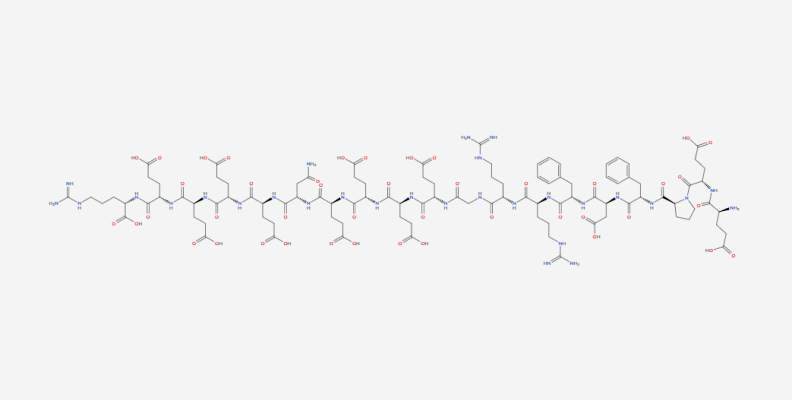
| Product Name | Bivalirudin |
| Synonyms | Angiomax, Angiox, BG-8967, Bivalirudin TFA |
| CAS Number | 128270-60-0 (TFA salt also supplied) |
| Sequence (3-Letter) | H-D-Phe-Pro-Arg-Pro-Gly-Gly-Gly-Gly-Asn-Gly-Asp-Phe-Glu-Glu-Ile-Pro-Glu-Glu-Tyr-Leu-OH |
| Sequence (1-Letter) | fPRPGGGGNGDFEEIPEEYL (f = D-Phe) |
| Molecular Formula | C₉₈H₁₃₈N₂₄O₃₃ (anhydrous free base) |
| Molecular Weight | 2180.29 (free base; TFA salt 2294.34) |
| Category | Drug Peptide – Direct Thrombin Inhibitor |
| Purity | ≥98% (by HPLC) |
| Appearance | White to off-white lyophilized powder |
| Counter Ion | TFA salt (acetate / TFA-free available on request) |
| Peptide Content | ≥90% (per specification) |
| Solubility | Soluble in water |
| Storage | -20°C, desiccated, protected from light |
| Available Scale | mg – kg (research quantities to scale-up batches) |
| QC Documentation | COA, HPLC, MS identity (additional API/regulatory documentation on request) |
| Usage | For research and pharmaceutical development use, and as a reference standard or active pharmaceutical ingredient for manufacturing. Not for human or veterinary use; not for sale to patients. Any therapeutic use is subject to applicable regulatory approval. |
Bivalirudin is a synthetic 20-amino-acid peptide and a direct thrombin inhibitor, known as a medicine under the brand names Angiomax and Angiox (CAS 128270-60-0). It is a synthetic analog of hirudin, the natural anticoagulant from the medicinal leech. We supply it as a white powder for research and pharmaceutical development.
Bivalirudin is a bivalent thrombin inhibitor: one end binds the active, catalytic site of thrombin and the other binds exosite-1, the site thrombin uses to grip fibrin. By occupying both it blocks thrombin from driving clot formation. The binding is reversible, because thrombin slowly cleaves the peptide near its N-terminus, which is part of why it is short-acting.
Clinically, bivalirudin is used as an anticoagulant during procedures such as percutaneous coronary intervention, often as an alternative to heparin. This is background information only; the material we supply is for research and pharmaceutical manufacturing use, and is not for human or veterinary use and not for sale to patients.
We supply Bivalirudin with a certificate of analysis, HPLC purity data, and mass-spec identity confirmation. Additional documentation to support API and regulatory work is available on request. Salt form and purity can be set to your specification.
Yes. We manufacture Bivalirudin in-house and supply from research quantities up to large scale-up batches. Contact us with your required purity, salt form, and quantity for a quote.
Bivalirudin is a synthetic peptide and a direct thrombin inhibitor, known as a medicine under the brand names Angiomax and Angiox. It is a rationally designed analog of hirudin, the natural anticoagulant found in the saliva of the medicinal leech. We supply it as a raw material for research and pharmaceutical development.
Bivalirudin is a 20-amino-acid peptide with the sequence H-D-Phe-Pro-Arg-Pro-(Gly)4-Asn-Gly-Asp-Phe-Glu-Glu-Ile-Pro-Glu-Glu-Tyr-Leu-OH, beginning with a D-phenylalanine residue. Its CAS number is 128270-60-0, the anhydrous free-base molecular formula is C98H138N24O33, and the free-base molecular weight is about 2180 daltons; it is commonly supplied as the trifluoroacetate salt.
Thrombin is the enzyme that converts fibrinogen into fibrin and drives clot formation. Bivalirudin is a bivalent inhibitor: one part of the peptide binds the catalytic (active) site of thrombin, while the other binds exosite-1, the region thrombin uses to recognise fibrin. Occupying both blocks thrombin activity against both free and clot-bound thrombin. The inhibition is reversible: thrombin slowly cleaves the bond near the N-terminus of bivalirudin, which restores thrombin function and contributes to the short duration of action.
Bivalirudin is used clinically as an intravenous anticoagulant, for example during percutaneous coronary intervention, where it is one alternative to heparin. This information is provided as scientific and reference background only. The material supplied by SynPeptide is intended for research and pharmaceutical manufacturing, is not for human or veterinary use, and is not for sale to patients; any therapeutic use is subject to applicable regulatory approval.
We supply Bivalirudin with a certificate of analysis, HPLC purity data, and mass-spectrometry identity confirmation, with additional documentation available to support active pharmaceutical ingredient and regulatory work. Purity, salt form, and counter-ion can be set to your specification for use as a reference standard or in process development.
We manufacture Bivalirudin by solid-phase synthesis and supply it from research quantities through to scale-up batches. For related capabilities, see drug peptides, custom peptide synthesis, large-scale peptide synthesis, and our peptide CDMO services. Material is supplied for research and pharmaceutical manufacturing use only.


