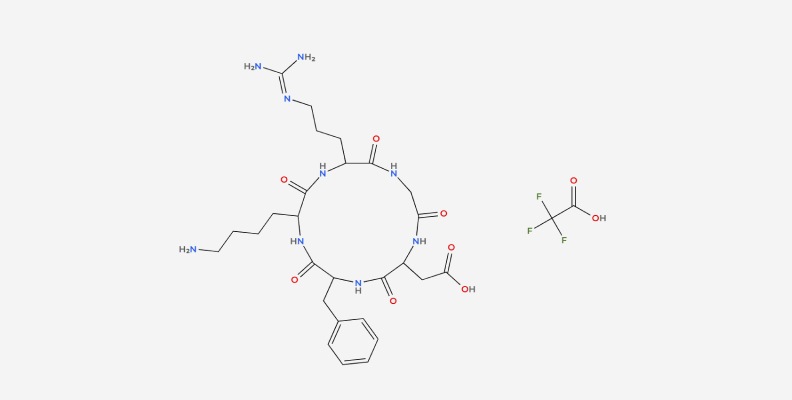
| Product Name | c(RGDfK) |
| Synonyms | Cyclo(-RGDfK); Cyclo(Arg-Gly-Asp-D-Phe-Lys); cyclo(-Arg-Gly-Asp-D-Phe-Lys); cyclic RGD peptide; αvβ3 integrin ligand |
| CAS Number | 161552-03-0 |
| Sequence | Cyclo(-Arg-Gly-Asp-D-Phe-Lys-) (head-to-tail cyclic pentapeptide) |
| One-Letter | cyclo(-RGDfK) (f = D-Phe) |
| Cyclization | Head-to-tail backbone amide (homodetic cyclic pentapeptide; no disulfide) |
| Conjugation Handle | Lysine ε-amine (for dyes, chelators/radiolabels, drugs, carriers) |
| Molecular Formula | C₂₇H₄₁N₉O₇ |
| Molecular Weight | 603.7 |
| Category | Cyclopeptide – RGD integrin-targeting peptide (αvβ3 ligand) |
| Purity | ≥98% (by HPLC); higher specifications available on request |
| Appearance | White to off-white solid (lyophilized powder or crystalline solid) |
| Counter Ion | Trifluoroacetate (TFA); acetate available on request |
| Cyclization | Head-to-tail backbone amide; no disulfide |
| Conjugation Handle | Lysine ε-amine |
| Water Content | Per specification (Karl Fischer) |
| Solubility | Soluble in water and DMSO |
| Storage | -20°C, desiccated, protected from light |
| Available Scale | mg to gram (research and process development); larger scale on enquiry |
| QC Documentation | COA, HPLC, MS identity; amino-acid analysis on request |
| Usage | For research and manufacturing use only. Not a finished medicine; not for human or veterinary use; not for sale to patients or individuals. Customers are responsible for regulatory and intellectual-property compliance in their territory. |
c(RGDfK) is a cyclic pentapeptide that carries the Arg-Gly-Asp, or RGD, motif and binds integrins, in particular the αvβ3 integrin. Its sequence is cyclo(-Arg-Gly-Asp-D-Phe-Lys-), where the lowercase f marks a D-phenylalanine, and it has CAS 161552-03-0 and the molecular formula C27H41N9O7 in its free-base form. We make it in-house and supply it as a synthetic peptide for research and manufacturing use.
c(RGDfK) is closed head-to-tail, so its backbone forms a continuous ring of five residues instead of an open chain. This ring holds the Arg-Gly-Asp motif in a fixed, bent shape that fits the integrin binding site far better than a flexible linear sequence, which is why the cyclic form binds tightly and selectively. The single D-phenylalanine helps set this shape and makes the peptide more stable against enzymes.
The lysine sits on the ring away from the Arg-Gly-Asp motif, so its side-chain amine can be used to attach other molecules without blocking integrin binding. Researchers use this handle to link c(RGDfK) to fluorescent dyes, chelators and radiolabels, drug molecules, polymers, and nanoparticles. This is what makes the peptide a popular targeting group for tumour imaging and for delivering payloads to integrin-rich cells.
We supply c(RGDfK) as a synthetic peptide at high HPLC purity with a certificate of analysis, an HPLC chromatogram, and mass-spec identity confirmation. Research and process-development specifications are available, and we can also prepare labelled or conjugated versions to order. Salt form, purity, and quantity can be set to your specification.
No. c(RGDfK) supplied by SynPeptide is a raw material for research and pharmaceutical development, analysis, and manufacturing only. It is not a finished medicine, it is not for human or veterinary use, and it is not sold to patients or individuals for personal use. Any clinical or commercial medicinal use is the responsibility of an appropriately licensed party and is subject to the relevant regulatory approvals.
c(RGDfK), or cyclo(-Arg-Gly-Asp-D-Phe-Lys-), is a cyclic pentapeptide built around the RGD integrin-recognition motif and one of the most widely used integrin-targeting peptides in research. The αvβ3 integrin it binds is strongly expressed on tumour cells and growing blood vessels but weakly on most normal tissue, which makes c(RGDfK) a useful targeting group. We supply it as a synthetic peptide for research and manufacturing use; it is not a finished medicine and not for human use.
c(RGDfK) is a head-to-tail cyclic peptide made of five residues: arginine, glycine, aspartic acid, D-phenylalanine, and lysine, with the one-letter shorthand cyclo(-RGDfK) in which the lowercase f marks the D-phenylalanine. Its molecular formula is C27H41N9O7 and its molecular weight is about 603.7. The Arg-Gly-Asp sequence is the part that integrins recognise, the D-phenylalanine sets the ring geometry, and the lysine provides a free amine for attaching other molecules. Its close analogue c(RGDyK) carries a D-tyrosine in place of the D-phenylalanine, adding a phenol handle for direct radioiodination.
The RGD motif is found in many natural matrix proteins, but a short linear RGD peptide is floppy and binds integrins only weakly. Closing the peptide into a ring locks the Arg-Gly-Asp motif into the bent shape that the αvβ3 integrin prefers, raising both affinity and selectivity, and the D-phenylalanine in the ring both fixes this shape and protects the peptide from rapid breakdown. This is why constrained cyclic RGD peptides, rather than linear ones, are the standard tools for integrin targeting.
A key feature of c(RGDfK) is that the lysine side chain points away from the binding motif, so its amine can be used to attach cargo without interfering with integrin binding. This handle is used to couple the peptide to fluorescent dyes for cell imaging, to chelators and radiolabels for PET and SPECT tracers, to cytotoxic drugs and photosensitisers, and to polymers, micelles, and nanoparticles for targeted delivery. Because the conjugation chemistry is well defined, c(RGDfK) is a reliable building block for making targeted imaging and delivery agents.
c(RGDfK) is used as an integrin ligand and antagonist in studies of cell adhesion, angiogenesis, and tumour biology, as a targeting group in molecular imaging probes, and as a homing element in drug-delivery and biomaterial systems where RGD-integrin binding improves cell attachment. We supply it at research and process-development scale with full analytical data so it can be used consistently across these settings.
Store the solid at -20°C, kept dry and protected from light. c(RGDfK) is a stable cyclic peptide with no disulfide bond, but the aspartic acid and the backbone amides mean strongly acidic or basic conditions and high temperatures should be avoided during handling and conjugation. It dissolves in water and in DMSO; prepare stock solutions fresh where possible, aliquot to avoid repeated freeze-thaw, and follow the certificate of analysis for lot-specific content.
We make c(RGDfK) and related cyclic RGD peptides by solid-phase synthesis with head-to-tail cyclization, and release them with a certificate of analysis, HPLC purity data, and mass-spectrometry identity confirmation, with salt form and scale set to your specification. Cyclization, side-chain labelling, and conjugate preparation are handled through our peptide modification and custom peptide synthesis services, and this product sits in our cyclopeptides range. Material is supplied for research and manufacturing use only; customers are responsible for the regulatory and intellectual-property requirements that apply in their territory.


