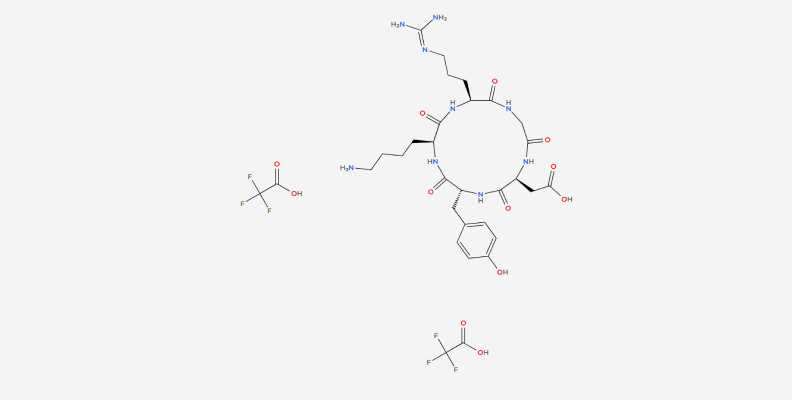
| Product Name | c(RGDyK) |
| Synonyms | Cyclo(-RGDyK); Cyclo(Arg-Gly-Asp-D-Tyr-Lys); cyclo(-Arg-Gly-Asp-D-Tyr-Lys); cyclic RGD peptide; αvβ3 integrin ligand |
| CAS Number | 217099-14-4 (also reported as 250612-42-1) |
| Sequence | Cyclo(-Arg-Gly-Asp-D-Tyr-Lys-) (head-to-tail cyclic pentapeptide) |
| One-Letter | cyclo(-RGDyK) (y = D-Tyr) |
| Cyclization | Head-to-tail backbone amide (homodetic cyclic pentapeptide; no disulfide) |
| Labeling Handles | Tyrosine phenol (direct radioiodination) and lysine ε-amine (dyes, chelators, carriers) |
| Molecular Formula | C₂₇H₄₁N₉O₈ |
| Molecular Weight | 619.7 |
| Category | Cyclopeptide – RGD integrin-targeting peptide (αvβ3 ligand) |
| Purity | ≥98% (by HPLC); higher specifications available on request |
| Appearance | White to off-white solid (lyophilized powder) |
| Counter Ion | Trifluoroacetate (TFA); acetate available on request |
| Cyclization | Head-to-tail backbone amide; no disulfide |
| Labeling Handles | Tyrosine phenol (radioiodination); lysine ε-amine (conjugation) |
| Water Content | Per specification (Karl Fischer) |
| Solubility | Soluble in water and DMSO |
| Storage | -20°C, desiccated, protected from light |
| Available Scale | mg to gram (research and process development); larger scale on enquiry |
| QC Documentation | COA, HPLC, MS identity; amino-acid analysis on request |
| Usage | For research and manufacturing use only. Not a finished medicine; not for human or veterinary use; not for sale to patients or individuals. Customers are responsible for regulatory and intellectual-property compliance in their territory. |
c(RGDyK) is a cyclic pentapeptide that carries the Arg-Gly-Asp, or RGD, motif and binds integrins, in particular the αvβ3 integrin. Its sequence is cyclo(-Arg-Gly-Asp-D-Tyr-Lys-), where the lowercase y marks a D-tyrosine, and it has CAS 217099-14-4 and the molecular formula C27H41N9O8 in its free-base form. We make it in-house and supply it as a synthetic peptide for research and manufacturing use.
c(RGDyK) is the tyrosine version of c(RGDfK): the two peptides share the same ring and the same Arg-Gly-Asp motif, but c(RGDyK) has a D-tyrosine where c(RGDfK) has a D-phenylalanine. The only chemical difference is the extra hydroxyl on the tyrosine, which adds one oxygen and slightly raises the molecular weight. That hydroxyl is also a reactive site, which is the main practical reason to choose c(RGDyK) over c(RGDfK).
The tyrosine and lysine give c(RGDyK) two separate attachment points away from the binding motif. The phenol ring of the tyrosine can be iodinated directly, which is widely used to make radioiodine-labelled tracers for imaging, while the side-chain amine of the lysine can be coupled to fluorescent dyes, chelators, drugs, or carriers. Because the two handles are different, c(RGDyK) can even carry two kinds of label at once for dual optical and radioactive probes.
We supply c(RGDyK) as a synthetic peptide at high HPLC purity with a certificate of analysis, an HPLC chromatogram, and mass-spec identity confirmation. Research and process-development specifications are available, and we can also prepare labelled or conjugated versions to order. Salt form, purity, and quantity can be set to your specification.
No. c(RGDyK) supplied by SynPeptide is a raw material for research and pharmaceutical development, analysis, and manufacturing only. It is not a finished medicine, it is not for human or veterinary use, and it is not sold to patients or individuals for personal use. Any clinical or commercial medicinal use is the responsibility of an appropriately licensed party and is subject to the relevant regulatory approvals.
c(RGDyK), or cyclo(-Arg-Gly-Asp-D-Tyr-Lys-), is a cyclic pentapeptide built around the RGD integrin-recognition motif and one of the most widely used scaffolds for building αvβ3-targeted imaging agents. The αvβ3 integrin it binds is strongly expressed on tumour cells and growing blood vessels but weakly on most normal tissue, which makes c(RGDyK) a useful targeting group. We supply it as a synthetic peptide for research and manufacturing use; it is not a finished medicine and not for human use.
c(RGDyK) is a head-to-tail cyclic peptide made of five residues: arginine, glycine, aspartic acid, D-tyrosine, and lysine, with the one-letter shorthand cyclo(-RGDyK) in which the lowercase y marks the D-tyrosine. Its molecular formula is C27H41N9O8 and its molecular weight is about 619.7. The Arg-Gly-Asp sequence is the part that integrins recognise, the D-tyrosine both sets the ring geometry and provides a site for iodination, and the lysine provides a free amine for attaching other molecules.
c(RGDyK) is the close relative of c(RGDfK). Both are cyclic RGD pentapeptides with the same ring, the same Arg-Gly-Asp motif, and a lysine handle, and they differ only in one residue: c(RGDyK) carries a D-tyrosine while c(RGDfK) carries a D-phenylalanine. The extra phenol hydroxyl on the tyrosine adds one oxygen, raises the molecular weight from about 603.7 to about 619.7, and, more importantly, gives a site that can be radioiodinated. Where a project needs only an amine handle, c(RGDfK) is often used; where direct iodine labelling is wanted, c(RGDyK) is the usual choice.
A key feature of c(RGDyK) is that it offers two independent attachment points that sit away from the binding motif. The phenol of the tyrosine can be iodinated directly, which is the basis for radioiodine-labelled RGD tracers used to image αvβ3 expression by PET and SPECT, and tyrosine-specific reagents can also be used at this site. The lysine amine, separately, can be coupled to dyes such as Cy5.5 through an active ester, or to chelators, drugs, polymers, and nanoparticles. Because the two handles react differently, c(RGDyK) can carry an optical and a radioactive label at the same time for dual-modality probes.
c(RGDyK) is used as an integrin ligand and antagonist in studies of cell adhesion, angiogenesis, and tumour biology, and above all as the targeting group in molecular imaging probes, from radioiodinated and chelator-based radiotracers to near-infrared optical agents. It is also used as a homing element in targeted drug delivery and in photodynamic-therapy conjugates. We supply it at research and process-development scale with full analytical data so it can be used consistently across these settings.
Store the solid at -20°C, kept dry and protected from light. c(RGDyK) is a stable cyclic peptide with no disulfide bond, but the tyrosine phenol can oxidise and the aspartic acid and backbone amides mean strongly acidic or basic conditions and high temperatures should be avoided during handling and labelling. It dissolves in water and in DMSO; prepare stock solutions fresh where possible, aliquot to avoid repeated freeze-thaw, and follow the certificate of analysis for lot-specific content.
We make c(RGDyK) and related cyclic RGD peptides by solid-phase synthesis with head-to-tail cyclization, and release them with a certificate of analysis, HPLC purity data, and mass-spectrometry identity confirmation, with salt form and scale set to your specification. Cyclization, radioiodination-ready and side-chain labelling, and conjugate preparation are handled through our peptide modification and custom peptide synthesis services, and this product sits in our cyclopeptides range. Material is supplied for research and manufacturing use only; customers are responsible for the regulatory and intellectual-property requirements that apply in their territory.


