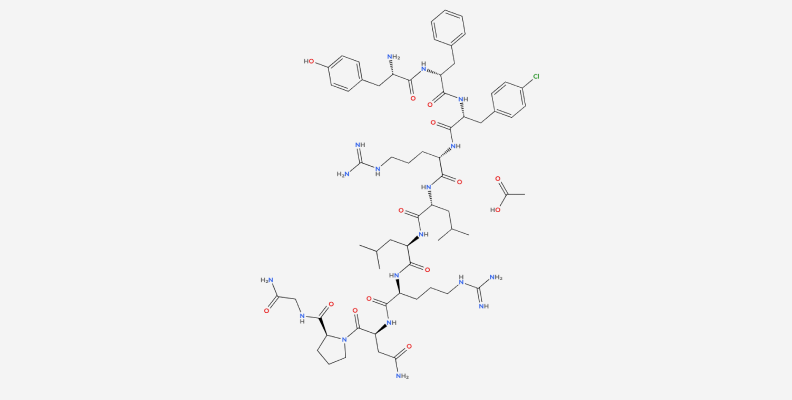
| Product Name | Cetrorelix Acetate |
| Synonyms | Cetrorelix, Cetrotide, SB-075, NS-75A, [Ac-D-Nal1, D-Cpa2, D-Pal3, D-Cit6, D-Ala10]-GnRH |
| CAS Number | 130143-01-0 (diacetate); free base 120287-85-6 |
| Sequence (3-Letter) | Ac-D-Nal(2)-D-Phe(4-Cl)-D-Pal(3)-Ser-Tyr-D-Cit-Leu-Arg-Pro-D-Ala-NH₂ |
| Sequence (1-Letter) | Ac-[D-2Nal]-[D-4ClPhe]-[D-3Pal]-S-Y-[D-Cit]-L-R-P-[D-Ala]-NH₂ |
| Molecular Formula | C₇₀H₉₂ClN₁₇O₁₄ (anhydrous free base) |
| Molecular Weight | 1431.06 (anhydrous free base) |
| Category | Drug Peptide – GnRH Antagonist |
| Purity | ≥98% (by HPLC) |
| Appearance | White to off-white lyophilized powder |
| Counter Ion | Acetate (supplied as the diacetate; salt form per specification) |
| Peptide Content | ≥80% (per specification) |
| Solubility | Soluble in water |
| Storage | -20°C, desiccated, protected from light |
| Available Scale | mg – kg (research quantities to scale-up batches) |
| QC Documentation | COA, HPLC, MS identity (additional API/regulatory documentation on request) |
| Usage | For research and pharmaceutical development use, and as a reference standard or active pharmaceutical ingredient for manufacturing. Not for human or veterinary use; not for sale to patients. Any therapeutic use is subject to applicable regulatory approval. |
Cetrorelix Acetate is the acetate salt of cetrorelix, a synthetic decapeptide and gonadotropin-releasing hormone (GnRH) antagonist, known as a medicine under the brand name Cetrotide (CAS 130143-01-0; free base 120287-85-6). It is an analog of natural GnRH with non-natural and D-amino acid substitutions at positions one, two, three, six, and ten, and an acetyl group at the N-terminus. We supply it as a white powder for research and pharmaceutical development.
Cetrorelix is a GnRH antagonist. It competes with natural GnRH at the receptor on the pituitary and blocks it, so the pituitary quickly releases less LH and FSH. Unlike GnRH agonists, it does this without an initial surge of hormones, so the suppression is immediate. Its several non-natural amino acids make it potent and resistant to breakdown.
Clinically, cetrorelix is used in assisted reproduction, where it prevents a premature LH surge during controlled ovarian stimulation so that egg collection can be timed for IVF. This is background information only; the material we supply is for research and pharmaceutical manufacturing use, and is not for human or veterinary use and not for sale to patients.
We supply Cetrorelix Acetate with a certificate of analysis, HPLC purity data, and mass-spec identity confirmation. Additional documentation for API and regulatory work is available on request, and acetate content and purity can be set to your specification.
Yes. We manufacture Cetrorelix Acetate in-house and supply from research quantities up to scale-up batches. Contact us with your required purity, salt form, and quantity for a quote.
Cetrorelix Acetate is the acetate salt of cetrorelix, a synthetic decapeptide and gonadotropin-releasing hormone (GnRH) antagonist. It is known as a medicine under the brand name Cetrotide and is widely used in assisted reproduction. We supply it as a raw material for research and pharmaceutical development.
Cetrorelix is a ten-residue peptide based on natural GnRH but heavily modified: it carries non-natural and D-amino acids at positions one, two, three, six, and ten, an acetyl group at the N-terminus, and a C-terminal amide. These changes are what give it antagonist activity and stability. Its diacetate-salt CAS number is 130143-01-0 (free base 120287-85-6), the anhydrous free-base molecular formula is C70H92ClN17O14, and the free-base molecular weight is about 1431.
Cetrorelix is a GnRH receptor antagonist. It competes with natural GnRH at the receptor on the pituitary and blocks it, so the pituitary quickly produces less luteinising hormone (LH) and follicle-stimulating hormone (FSH). This is the opposite approach to a GnRH agonist such as triptorelin, which first stimulates and only later suppresses the pituitary; an antagonist suppresses LH and FSH immediately, without the initial surge.
Cetrorelix is used clinically in assisted reproduction, where it prevents a premature LH surge during controlled ovarian stimulation, allowing egg collection to be timed for in-vitro fertilisation. This information is provided as scientific and reference background only. The material supplied by SynPeptide is intended for research and pharmaceutical manufacturing, is not for human or veterinary use, and is not for sale to patients; any therapeutic use is subject to applicable regulatory approval.
We supply Cetrorelix Acetate with a certificate of analysis, HPLC purity data, and mass-spectrometry identity confirmation, with further documentation available to support active pharmaceutical ingredient and regulatory work. Because it contains several non-natural residues, it calls for careful synthesis and purification; purity, salt form, and acetate content can be set to your specification for use as a reference standard or in process development.
We manufacture Cetrorelix Acetate by solid-phase synthesis, including its non-natural and D-amino acid residues, and supply it from research quantities through to scale-up batches. For related capabilities, see drug peptides, custom peptide synthesis, and peptide modification. Material is supplied for research and pharmaceutical manufacturing use only.


