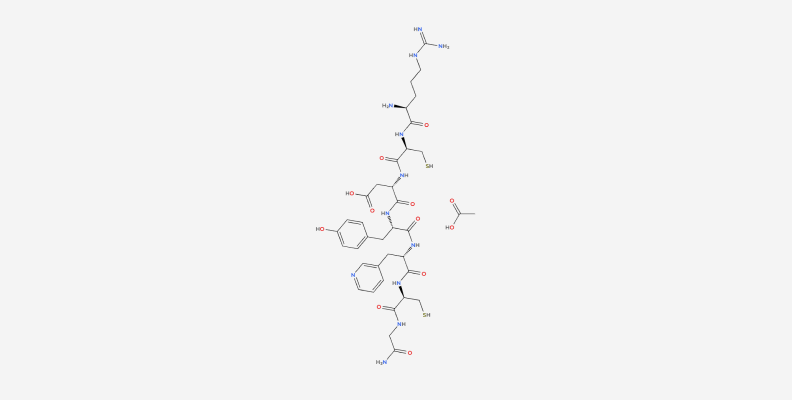
| Product Name | Eptifibatide |
| Synonyms | Integrilin, Integrelin, Intrifiban; Mpa-Har-Gly-Asp-Trp-Pro-Cys-NH₂ cyclic (1→6)-disulfide |
| CAS Number | 188627-80-7 (anhydrous form 148031-34-9) |
| Sequence (3-Letter) | Mpa-Har-Gly-Asp-Trp-Pro-Cys-NH₂ (cyclic (1→6)-disulfide; Mpa = 3-mercaptopropionyl, Har = homoarginine) |
| Sequence (1-Letter) | Mpa-hArg-G-D-W-P-C-NH₂ (cyclic Mpa–Cys disulfide) |
| Molecular Formula | C₃₅H₄₉N₁₁O₉S₂ |
| Molecular Weight | 831.96 |
| Category | Drug Peptide – GPIIb/IIIa Receptor Antagonist |
| Purity | ≥98% (by HPLC) |
| Appearance | White to off-white powder |
| Counter Ion | Acetate (salt form per specification) |
| Peptide Content | ≥80% (per specification) |
| Solubility | Soluble in water |
| Storage | -20°C, desiccated, protected from light |
| Available Scale | mg – kg (research quantities to scale-up batches) |
| QC Documentation | COA, HPLC, MS identity, disulfide-connectivity confirmation (additional API/regulatory documentation on request) |
| Usage | For research and pharmaceutical development use, and as a reference standard or active pharmaceutical ingredient for manufacturing. Not for human or veterinary use; not for sale to patients. Any therapeutic use is subject to applicable regulatory approval. |
Eptifibatide is a synthetic cyclic heptapeptide and a platelet glycoprotein IIb/IIIa receptor antagonist, known as a medicine under the brand name Integrilin (CAS 188627-80-7). It is built from six amino acids plus a mercaptopropionyl group and is closed into a ring by a disulfide bond. Its design is based on a protein from snake venom, and it carries a homoarginine-glycine-aspartate motif that fits the GPIIb/IIIa receptor. We supply it as a white powder for research and pharmaceutical development.
Eptifibatide blocks the final step of platelet clumping. On activated platelets, the glycoprotein IIb/IIIa receptor normally grabs fibrinogen and von Willebrand factor to bridge platelets together. Eptifibatide binds that receptor reversibly and blocks it, so the platelets cannot link up and a clot cannot form. Because the binding is reversible and short-lived, its effect wears off quickly after dosing stops.
Clinically, eptifibatide is used as an antiplatelet drug in acute coronary syndromes and in patients undergoing coronary angioplasty and stenting, usually together with heparin and aspirin. This is background information only; the material we supply is for research and pharmaceutical manufacturing use, and is not for human or veterinary use and not for sale to patients.
We supply Eptifibatide with a certificate of analysis, HPLC purity data, and mass-spec identity confirmation, and we can confirm the disulfide connectivity. Additional documentation for API and regulatory work is available on request, and salt form and purity can be set to your specification.
Yes. We manufacture Eptifibatide in-house and supply from research quantities up to scale-up batches. Contact us with your required purity, salt form, and quantity for a quote.
Eptifibatide is a synthetic cyclic heptapeptide and a platelet glycoprotein IIb/IIIa receptor antagonist, used as an antiplatelet agent. It is known as a medicine under the brand name Integrilin and its design is based on a protein from snake venom. We supply it as a raw material for research and pharmaceutical development.
Eptifibatide is a small cyclic peptide made of six amino acids plus a mercaptopropionyl group, written as Mpa-Har-Gly-Asp-Trp-Pro-Cys-NH2 and closed into a ring by a disulfide bond between the mercaptopropionyl and the cysteine. It is modelled on barbourin, a protein from the venom of the southeastern pygmy rattlesnake, and carries a homoarginine-glycine-aspartate motif that is specific for the GPIIb/IIIa receptor. Its CAS number is 188627-80-7 (anhydrous form 148031-34-9), its molecular formula is C35H49N11O9S2, and its molecular weight is about 832.
Platelets stick together at the final step of clotting when the glycoprotein IIb/IIIa receptor on their surface binds fibrinogen and von Willebrand factor, bridging one platelet to the next. Eptifibatide binds the GPIIb/IIIa receptor reversibly and blocks it, so those bridges cannot form and platelets cannot aggregate. Because it binds reversibly and is short-acting, platelet function returns after the drug is stopped.
Eptifibatide is used clinically as an antiplatelet drug in acute coronary syndromes and in patients undergoing coronary angioplasty and stenting, usually alongside heparin and aspirin. This information is provided as scientific and reference background only. The material supplied by SynPeptide is intended for research and pharmaceutical manufacturing, is not for human or veterinary use, and is not for sale to patients; any therapeutic use is subject to applicable regulatory approval.
Eptifibatide combines a disulfide-closed ring with non-natural residues, so it needs careful synthesis and purification. We supply it with a certificate of analysis, HPLC purity data, mass-spectrometry identity confirmation, and confirmation of disulfide connectivity, with further documentation available to support active pharmaceutical ingredient and regulatory work, and purity and salt form set to your specification.
We manufacture Eptifibatide by solid-phase synthesis, including the homoarginine and mercaptopropionyl residues and the disulfide ring closure, and supply it from research quantities through to scale-up batches. For related capabilities, see drug peptides, custom peptide synthesis, peptide modification, and cyclic peptides. Material is supplied for research and pharmaceutical manufacturing use only.


