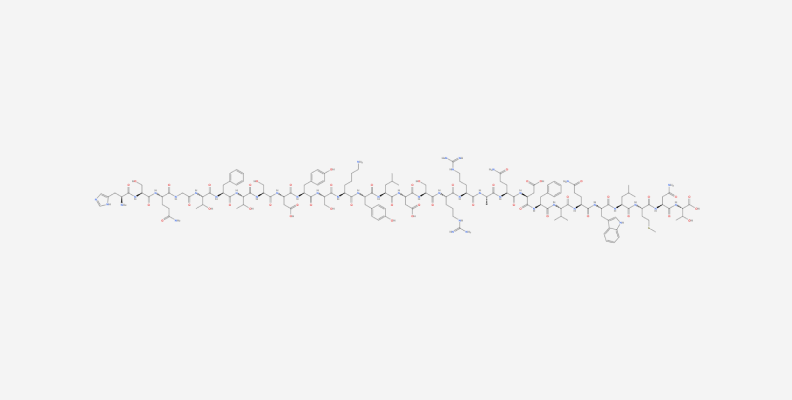
| Product Name | Glucagon |
| Synonyms | Glucagon (1-29) (human), GCG, pancreatic glucagon, HG-1; free-base peptide |
| CAS Number | 16941-32-5 (free base); hydrochloride salt 11140-85-5 |
| Sequence (3-Letter) | H-His-Ser-Gln-Gly-Thr-Phe-Thr-Ser-Asp-Tyr-Ser-Lys-Tyr-Leu-Asp-Ser-Arg-Arg-Ala-Gln-Asp-Phe-Val-Gln-Trp-Leu-Met-Asn-Thr-OH |
| Sequence (1-Letter) | HSQGTFTSDYSKYLDSRRAQDFVQWLMNT |
| Molecular Formula | C₁₅₃H₂₂₅N₄₃O₄₉S (free base) |
| Molecular Weight | 3482.75 (free base); hydrochloride salt ≈ 3519.2 |
| Category | Drug Peptide – Glucagon Receptor Agonist |
| Purity | ≥98% (by HPLC) |
| Appearance | White to off-white powder |
| Counter Ion | Free base / TFA (salt form per specification; hydrochloride also supplied) |
| Peptide Content | ≥80% (per specification) |
| Solubility | Poorly soluble in neutral water; soluble in dilute acid or dilute base; prone to aggregation |
| Storage | -20°C, desiccated, protected from light |
| Available Scale | mg – kg (research quantities to scale-up batches) |
| QC Documentation | COA, HPLC, MS identity (additional API/regulatory documentation on request) |
| Usage | For research and pharmaceutical development use, and as a reference standard or active pharmaceutical ingredient for manufacturing. Not for human or veterinary use; not for sale to patients. Any therapeutic use is subject to applicable regulatory approval. |
Glucagon is a 29-amino-acid peptide hormone made by the alpha cells of the pancreas (CAS 16941-32-5). Its sequence is HSQGTFTSDYSKYLDSRRAQDFVQWLMNT, a single linear chain with no chemical modifications, and it is the same across most mammals including humans. This product is the free-base peptide. We supply it as a white powder for research and pharmaceutical development.
Glucagon acts mainly in the liver, where it activates the glucagon receptor and drives the breakdown of stored glycogen and the making of new glucose, raising blood sugar. It is the counter-regulatory partner to insulin: where insulin lowers blood sugar, glucagon raises it. It also relaxes the smooth muscle of the gut.
They are the same peptide; the difference is the salt form. This product is the free-base peptide (CAS 16941-32-5), which is poorly soluble in neutral water. The hydrochloride salt dissolves more readily and is the form usually used in finished medicines. Pick the form that suits your assay or formulation.
We supply Glucagon with a certificate of analysis, HPLC purity data, and mass-spec identity confirmation. Additional documentation for API and regulatory work is available on request, and purity and form can be set to your specification, including supply as a reference standard.
Yes. We manufacture Glucagon in-house and supply from research quantities up to scale-up batches. Contact us with your required purity, salt form, and quantity for a quote.
Glucagon is the 29-amino-acid peptide hormone produced by the alpha cells of the pancreas, where it acts to raise blood sugar. It is the counter-regulatory partner to insulin. This page covers the free-base peptide; we also supply the more water-soluble glucagon hydrochloride salt. We supply both as raw materials for research and pharmaceutical development.
Glucagon is a single linear chain of 29 amino acids with the sequence HSQGTFTSDYSKYLDSRRAQDFVQWLMNT and no chemical modifications. The sequence is conserved across most mammals, including humans, which is why it is widely used as a reference peptide. Its free-base CAS number is 16941-32-5 (hydrochloride salt 11140-85-5), its free-base molecular formula is C153H225N43O49S, and its free-base molecular weight is about 3483.
Glucagon acts mainly on the liver, binding the glucagon receptor (GCGR). Through that receptor it stimulates the breakdown of stored glycogen into glucose and the synthesis of new glucose, raising blood sugar. This is the mirror image of insulin, which lowers blood sugar; the balance between the two hormones governs glucose control. Glucagon also relaxes gastrointestinal smooth muscle, an effect separate from its action on blood sugar.
The peptide is supplied either as the free base or as the hydrochloride salt. The free-base peptide on this page is poorly soluble in neutral water and is often dissolved in dilute acid for laboratory work; the hydrochloride salt dissolves in water more readily and is the form usually chosen for finished medicines. Both share the same sequence and biological behaviour.
Glucagon is used clinically to treat severe low blood sugar and as an aid during imaging of the digestive tract, and in research it is a standard tool in studies of metabolism and the glucagon receptor. This information is provided as scientific and reference background only. The material supplied by SynPeptide is intended for research and pharmaceutical manufacturing, is not for human or veterinary use, and is not for sale to patients; any therapeutic use is subject to applicable regulatory approval.
We manufacture Glucagon by solid-phase synthesis and supply it from research quantities through to scale-up batches, as the free base or as a salt. For related capabilities, see drug peptides, custom peptide synthesis, and large-scale peptide synthesis. Material is supplied for research and pharmaceutical manufacturing use only.


