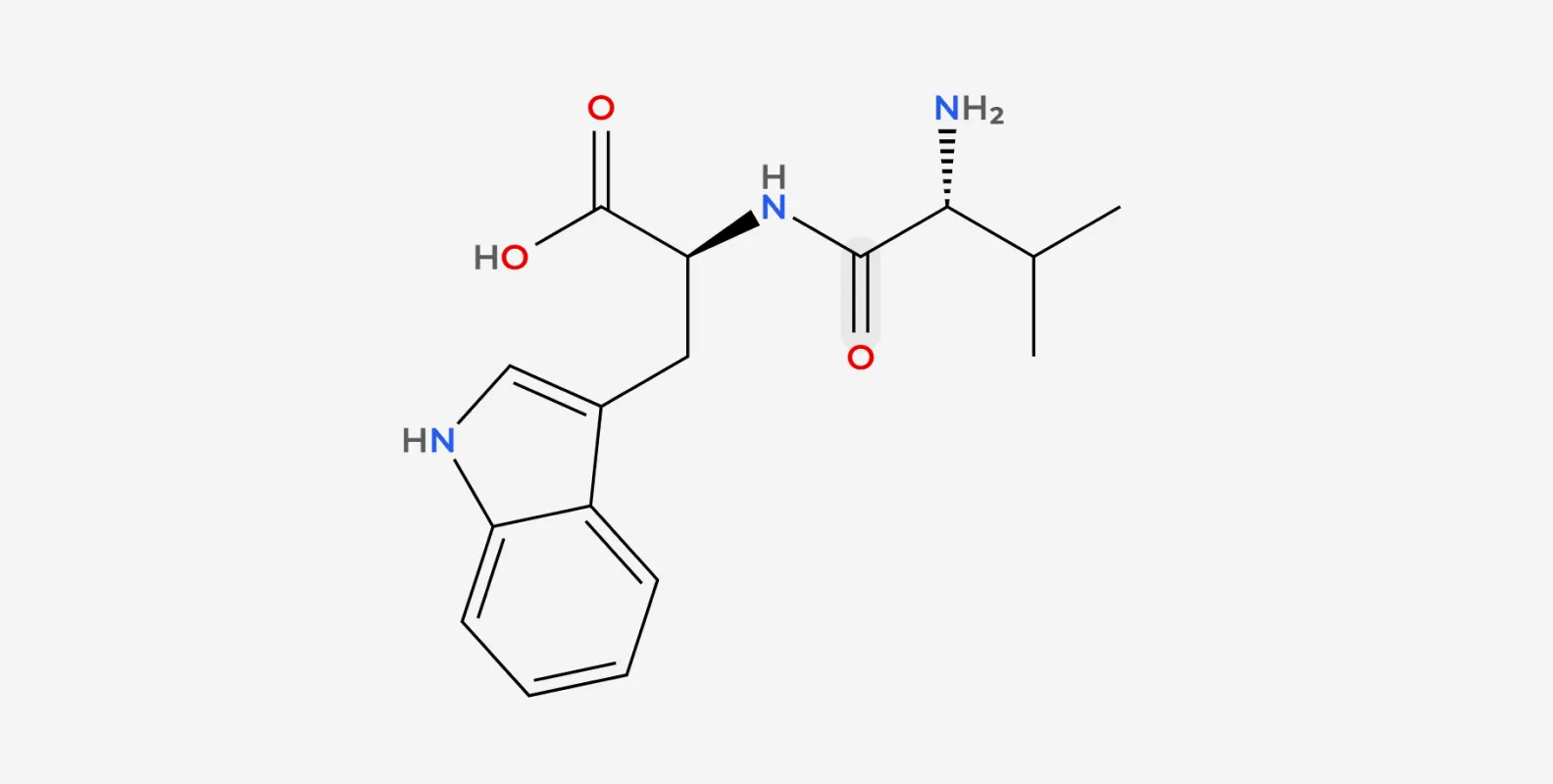
| Product Name | H-Val-Trp-OH (Dipeptide-2) |
| Synonyms | Dipeptide-2, Val-Trp, L-Valyl-L-tryptophan, N-Valyltryptophan, VW |
| CAS Number | 24587-37-9 |
| Sequence (3-Letter) | H-Val-Trp-OH |
| Sequence (1-Letter) | VW |
| Molecular Formula | C₁₆H₂₁N₃O₃ |
| Molecular Weight | 303.36 |
| Category | Cosmetic Peptide |
| Purity | ≥98% (by HPLC) |
| Appearance | White to off-white powder |
| Counter Ion | Free base / acetate (TFA-free available on request) |
| Peptide Content | ≥90% |
| Solubility | Soluble in water and DMSO; warming may assist |
| Storage | -20°C, desiccated, protected from light |
| Available Scale | mg – kg |
| QC Documentation | COA, HPLC, MS (included with every order) |
| Usage | For cosmetic formulation and research use only. Supplied as a raw material; finished-product efficacy and safety claims are the formulator's responsibility. Not a drug; not for direct use without formulation. |
H-Val-Trp-OH is the dipeptide valyl-tryptophan (Val-Trp), known in cosmetics as Dipeptide-2 (CAS 24587-37-9). It is a small two-amino-acid peptide, with valine at the N-terminus and tryptophan at the C-terminus, supplied as a white powder for skincare and research use.
Dipeptide-2 is used mainly in eye-care products to reduce the look of under-eye puffiness and dark circles. It acts as an inhibitor of angiotensin-converting enzyme (ACE), which supports local lymphatic drainage and fluid clearance around the eye. It is a common partner ingredient in anti-puffiness eye serums and creams.
The peptide inhibits ACE in the skin around the eye, which helps clear the fluid that builds up as puffiness and contributes to dark circles. This is a local cosmetic effect used at very low levels; it is not intended as a systemic or medical treatment. Efficacy in a finished product is the formulator's responsibility.
Dipeptide-2 is added at low concentration to leave-on eye products such as serums, gels, and creams, often alongside other peptides like Palmitoyl Tetrapeptide-7 in eye-bag formulas. It is water-soluble and straightforward to incorporate. We can advise on use levels and pairing.
Yes. We manufacture H-Val-Trp-OH in-house and supply from milligrams to kilograms, with COA, HPLC, and MS included. Contact us with your required purity and quantity for a quote.
H-Val-Trp-OH is the dipeptide valyl-tryptophan, known in cosmetics by its INCI name Dipeptide-2. It is one of the simplest bioactive peptides used in skincare, made of just two amino acids, and is best known as an eye-care ingredient that targets the look of under-eye puffiness and dark circles.
The molecule is L-valine joined to L-tryptophan through a single peptide bond, with a free N-terminus and C-terminus (H-Val-Trp-OH). Its CAS number is 24587-37-9 and its molecular formula is C16H21N3O3, with a molecular weight of about 303. In ingredient lists it appears as Dipeptide-2.
Dipeptide-2 acts as an inhibitor of angiotensin-converting enzyme (ACE). In an eye-care formula, this local activity is used to support lymphatic drainage and fluid clearance in the delicate skin around the eye, which is the rationale for its use against puffiness, eye bags, and dark circles. This is a topical cosmetic effect used at very low concentrations and is not intended as a systemic or medical treatment.
Dipeptide-2 is formulated into leave-on eye products such as serums, gels, and creams. It is often combined with other peptides, for example Palmitoyl Tetrapeptide-7, in anti-eye-bag systems, and it is water-soluble and straightforward to incorporate. As with all cosmetic actives, any claim made on the finished product is the responsibility of the formulator.
Dipeptide-2 is used at trace levels, typically a small fraction of a percent of the finished formula, and is handled as a standard cosmetic peptide raw material. Several suppliers also offer it as a research-use compound for studies of ACE inhibition and skin biology. Finished products should be safety-assessed for their specific formula and use.
We manufacture H-Val-Trp-OH by solid-phase synthesis and supply it from milligram to kilogram scale, each batch with a COA, HPLC, and MS report. For related ingredients and the underlying chemistry, see cosmetic peptides and custom peptide synthesis. This material is supplied for cosmetic formulation and research use and is not a drug.


