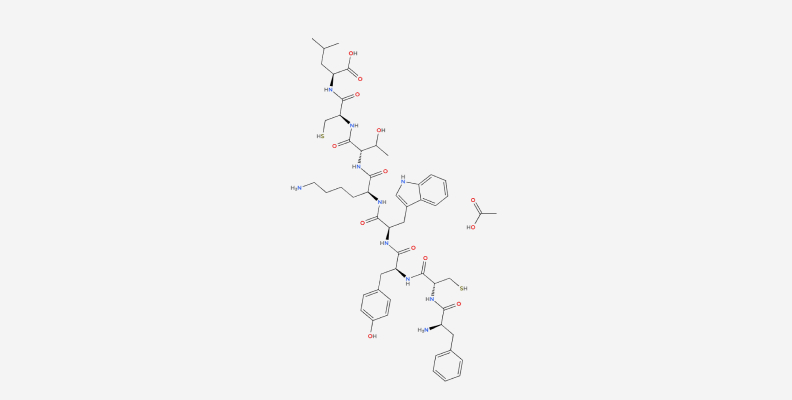
| Product Name | Lanreotide |
| Synonyms | BIM-23014; DC-13-116; Angiopeptin; somatostatin analogue |
| CAS Number | 108736-35-2 (free peptide); 127984-74-1 (acetate) |
| Sequence (3-Letter) | H-D-2-Nal-Cys-Tyr-D-Trp-Lys-Val-Cys-Thr-NH2 |
| Modified Residues | N-terminal D-2-naphthylalanine (D-2-Nal); D-tryptophan at position 4; C-terminal amide |
| Disulfide Bridge | Cys2–Cys7 (intramolecular) |
| Molecular Formula | C₅₄H₆₉N₁₁O₁₀S₂ |
| Molecular Weight | 1096.3 |
| Category | Drug Peptide Impurity / Reference Standard – lanreotide (somatostatin analogue) |
| Purity | ≥98% (by HPLC); reference-standard and pharmaceutical-grade specifications available |
| Appearance | White to off-white lyophilized powder |
| Counter Ion | Acetate (per specification) |
| Disulfide Bridge | Cys2–Cys7 (intramolecular) |
| Water Content | Per specification (Karl Fischer) |
| Related Substances | Characterised per specification; named impurity / related-substance reference standards available |
| Storage | -20°C, desiccated, protected from light |
| Available Scale | mg quantities (reference-standard and research); larger scale on enquiry |
| QC Documentation | COA, HPLC, MS identity; extended characterisation (related substances, peptide content) on request |
| Usage | For research and pharmaceutical analytical / quality-control use only, including as a reference standard for identity and related-substance testing. Not for human or veterinary use; not for sale to patients or individuals. Customers are responsible for regulatory and intellectual-property compliance in their territory. |
Lanreotide is a cyclic eight-residue somatostatin analogue with CAS 108736-35-2 and the molecular formula C54H69N11O10S2. Its sequence is H-D-2-Nal-Cys-Tyr-D-Trp-Lys-Val-Cys-Thr-NH2, with a C-terminal amide, two D-amino acids, and an intramolecular disulfide bridge between the cysteine residues at positions two and seven. It is closely related to octreotide, and we make it in-house and supply it as a synthetic lyophilized powder for research and analytical use, including as a reference standard.
Analytical and quality-control work needs a well-characterised reference standard of the active peptide to confirm identity, calibrate assays, and run system-suitability and related-substance tests. Lanreotide reference material is used this way in the control of lanreotide drug substances and products. We supply it with full identity and purity data so it can serve as the parent reference alongside named impurity standards.
Lanreotide is a disulfide-bridged, amidated peptide with two D-amino acids, so it can form a defined set of related substances during synthesis and storage. Common ones include disulfide-bond isomers and the open-chain reduced form, diastereomers from racemisation of the D-residues, deamidation and truncated species, and dimers. These are controlled in pharmacopoeial and in-house methods, and we can prepare named impurity and related-substance reference standards alongside the parent peptide for method development and stability work.
We supply Lanreotide as a synthetic peptide at high HPLC purity with a certificate of analysis, an HPLC chromatogram, and mass-spec identity confirmation. Reference-standard and pharmaceutical-grade specifications are available, including extended characterisation of related substances. Salt form, purity, and quantity can be set to your specification.
No. Lanreotide supplied by SynPeptide is a raw material for research and pharmaceutical development, analysis, and manufacturing only. It is not a finished medicine, it is not for human or veterinary use, and it is not sold to patients or individuals for personal use. Any clinical or commercial medicinal use is the responsibility of an appropriately licensed party and is subject to the relevant regulatory approvals.
Lanreotide (CAS 108736-35-2) is a cyclic octapeptide analogue of somatostatin and a well-established peptide drug substance for endocrine and oncology research. In a peptide impurity and reference-standard programme it is the parent compound against which related substances are measured, and we supply it as a synthetic peptide for research, analytical, and quality-control use, including as a reference standard. It is not supplied as a finished medicine and not for human use.
Lanreotide is a cyclic eight-residue peptide with the sequence H-D-2-Nal-Cys-Tyr-D-Trp-Lys-Val-Cys-Thr-NH2, a C-terminal amide, and an intramolecular disulfide bridge between Cys2 and Cys7. It is built on the somatostatin pharmacophore but uses non-natural residues, including an N-terminal D-2-naphthylalanine and a D-tryptophan, which make it far more stable and longer-acting than native somatostatin. Its molecular formula is C54H69N11O10S2 and its molecular weight is about 1096.3. It belongs to the same somatostatin-analogue class as octreotide.
Regulated peptide manufacturing needs reference standards to confirm identity, calibrate assays, and run system-suitability and related-substance tests. As a peptide drug substance with pharmacopoeial monographs, lanreotide is routinely controlled this way. We supply well-characterised lanreotide reference material with full identity and purity data, so it can serve as the parent reference alongside named impurity standards in method development, release testing, and stability studies.
Lanreotide is a small, disulfide-bridged, amidated peptide with two D-amino acids, so it can form a characteristic set of related substances during synthesis, purification, and storage. Typical ones include disulfide-bond isomers and the reduced open-chain form, diastereomers from racemisation at the D-naphthylalanine and D-tryptophan positions, oxidation, deamidation and truncated species, and dimers. These are the species that pharmacopoeial and in-house related-substance methods are designed to separate and limit, and we can prepare named impurity and related-substance reference standards to order.
Lanreotide is an agonist at somatostatin receptors, a family of G-protein-coupled receptors, with high affinity for the sst2 and sst5 subtypes. Through these receptors it inhibits the release of growth hormone and several other hormones and has antiproliferative effects, which is the basis for its research and clinical use in acromegaly and neuroendocrine tumours. This is provided as factual background; the material we supply is for research and analytical use, not for human or veterinary use, not for sale to patients, and carries no health or therapeutic claims.
Store the lyophilized peptide at -20°C, kept dry and protected from light. Because the molecule depends on its Cys2–Cys7 disulfide bridge, avoid reducing conditions and strong oxidants that could open or scramble the bond, and note that the D-amino acids and amide make controlled handling important to limit epimerisation and degradation. Lanreotide is also known to self-associate and gel at high concentration, so prepare stock solutions carefully, aliquot to avoid repeated freeze-thaw, and follow the certificate of analysis for lot-specific peptide and water content.
We make Lanreotide and its related-substance reference standards by solid-phase synthesis with controlled disulfide formation, and release them with a certificate of analysis, HPLC purity data, and mass-spectrometry identity confirmation, with grade and salt form set to your specification. Impurity and related-substance reference standards are prepared through our peptide modification and custom peptide synthesis services, and this product sits in our drug peptide impurities reference-standard range. Material is supplied for research and pharmaceutical analytical or manufacturing use only; customers are responsible for the regulatory and intellectual-property requirements that apply in their territory.


