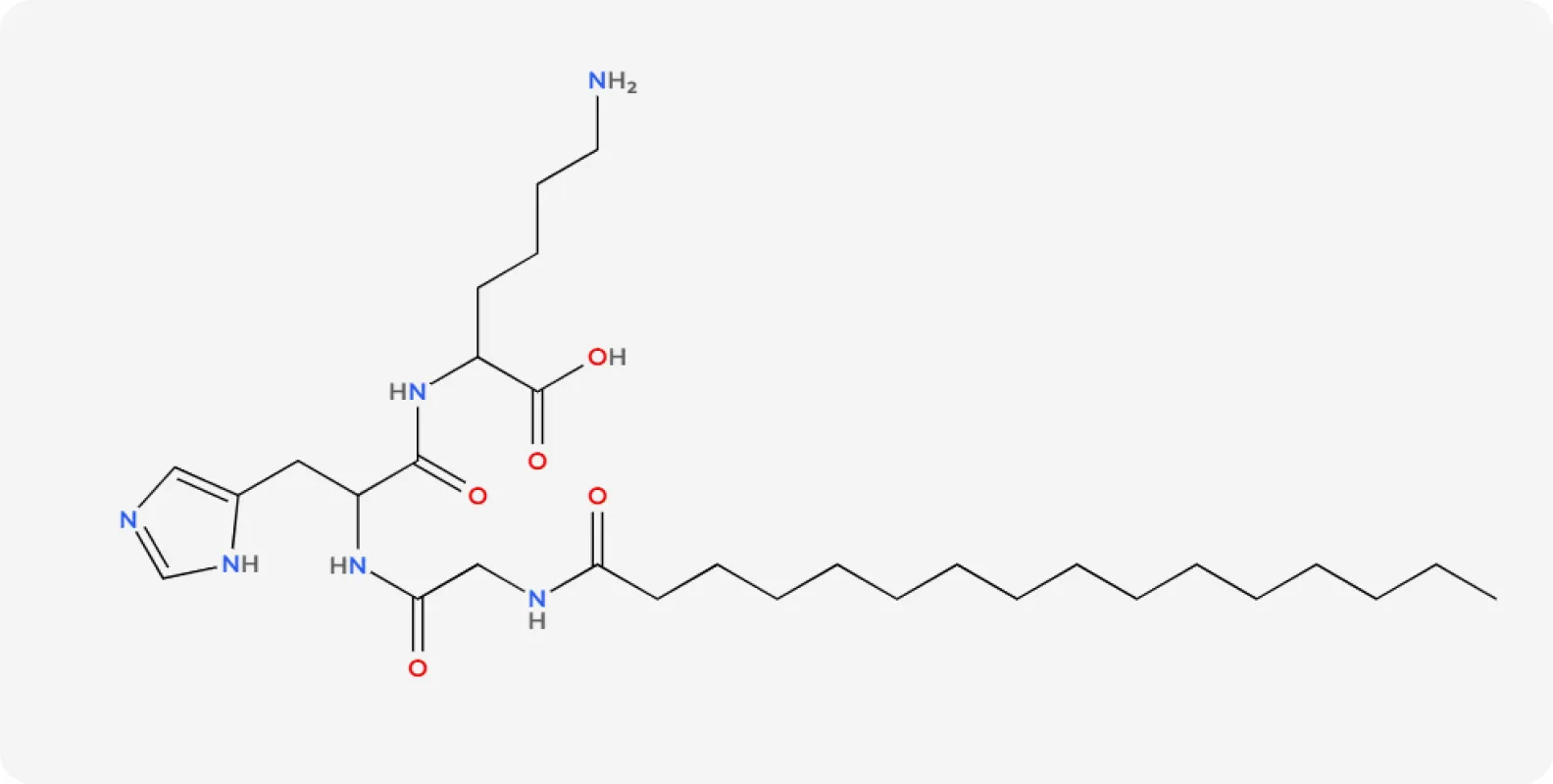
| Product Name | Palmitoyl Oligopeptide |
| Synonyms | Pal-VGVAPG, Palmitoyl Hexapeptide-12, Oligopeptide-34, Pal-Val-Gly-Val-Ala-Pro-Gly-OH |
| CAS Number | 171263-26-6 |
| Sequence (3-Letter) | Pal-Val-Gly-Val-Ala-Pro-Gly-OH |
| Sequence (1-Letter) | Pal-VGVAPG |
| Molecular Formula | C₃₈H₆₈N₆O₈ |
| Molecular Weight | 736.98 |
| Category | Cosmetic Peptide |
| Purity | ≥95% (by HPLC) |
| Appearance | White to off-white powder |
| Counter Ion | Acetate (TFA-free available on request) |
| Peptide Content | ≥80% |
| Solubility | Soluble in DMSO and warm ethanol; limited aqueous solubility (commonly used in liposomal or glycol formulations) |
| Storage | -20°C, desiccated, protected from light |
| Available Scale | mg – kg |
| QC Documentation | COA, HPLC, MS (included with every order) |
| Usage | For cosmetic formulation and research use only. Supplied as a raw material; finished-product efficacy and safety claims are the formulator's responsibility. Not a drug; not for direct use without formulation. |
Palmitoyl Oligopeptide is a lipopeptide cosmetic ingredient: a short peptide joined to palmitic acid, which makes it lipophilic so it can associate with the skin's lipid layers. The CAS 171263-26-6 form is the elastin-derived sequence Pal-VGVAPG, also listed as Palmitoyl Hexapeptide-12. The same name is also used for the collagen-fragment peptide Pal-GHK (Palmitoyl Tripeptide-1), one of the two peptides in Matrixyl 3000.
In skincare it is used as an anti-aging, firming, and smoothing ingredient. The sequences are fragments of skin matrix proteins, and suppliers position them as signal peptides intended to support the look of firmer, smoother skin. Any efficacy claim on a finished product is the formulator's responsibility.
The Cosmetic Ingredient Review panel has assessed palmitoyl oligopeptides and related palmitoyl peptides and found them safe as used in cosmetics at current concentrations. The ingredient is used at low levels, typically a fraction of a percent in a finished formula. As with any ingredient, finished products should be safety-assessed for their specific use.
It is added at low concentration to leave-on products such as serums, creams, and eye products. Because it is lipophilic and used at trace levels, it is often supplied pre-dissolved or as a liposomal or glycol dispersion to aid incorporation. We can advise on handling for your formulation.
Yes. We manufacture Palmitoyl Oligopeptide in-house and supply from milligrams to kilograms, with COA, HPLC, and MS included. Contact us with your target sequence, Pal-VGVAPG or Pal-GHK, plus purity and quantity for a quote.
Palmitoyl Oligopeptide is a lipopeptide used as an anti-aging active in skincare. It is built by attaching palmitic acid, a C16 fatty acid, to a short peptide derived from a skin matrix protein. The fatty acid makes the peptide lipophilic so it can associate with the skin's lipid layers, which is the rationale behind this family of palmitoyl peptides.
The name is used for more than one peptide, so the CAS number matters. This product, CAS 171263-26-6, is the elastin-derived sequence Pal-Val-Gly-Val-Ala-Pro-Gly (Pal-VGVAPG), also listed as Palmitoyl Hexapeptide-12 or Oligopeptide-34. The same trade name is also applied to Pal-Gly-His-Lys (Pal-GHK, Palmitoyl Tripeptide-1, CAS 147732-56-7), a fragment of type I collagen. Both are sold as Palmitoyl Oligopeptide, so it is worth confirming the sequence and CAS when sourcing.
These peptides are described as signal peptides: the sequences are fragments of matrix proteins such as elastin (VGVAPG) and collagen (GHK), and they are intended to signal skin cells to support the look of firmer, smoother skin. The palmitoyl chain improves lipid solubility and helps the peptide reach the layers where matrix proteins are made. As with all cosmetic actives, claims about results on a finished product are the responsibility of the formulator.
Palmitoyl Oligopeptide is best known as one half of Matrixyl 3000, where the GHK form (Pal-GHK) is paired with Palmitoyl Tetrapeptide-7 (Pal-GQPR). The two peptides are used together at trace levels in anti-aging serums and creams. The VGVAPG form in this product appears in other elastin-focused materials such as Dermaxyl-type blends.
The Cosmetic Ingredient Review has assessed palmitoyl oligopeptides and related palmitoyl peptides and concluded they are safe as used in cosmetics. They are used at very low concentrations, usually a fraction of a percent of the finished formula. Questions about whether the ingredient is comedogenic or irritating are generally addressed by the low use level, but any finished product should still be safety-assessed for its specific formula and use.
We manufacture Palmitoyl Oligopeptide by solid-phase synthesis and supply both the Pal-VGVAPG and Pal-GHK sequences from milligram to kilogram scale, each with a COA, HPLC, and MS report. For the underlying chemistry and the fatty-acid attachment step, see cosmetic peptides, custom peptide synthesis, and peptide modification. This material is supplied for cosmetic formulation and research use and is not a drug.


