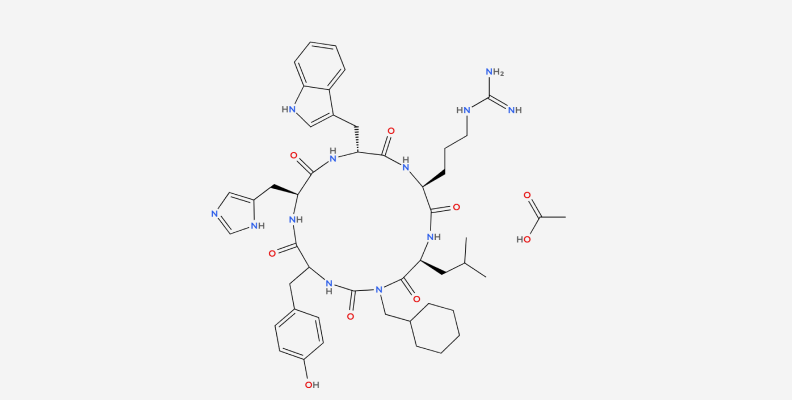
| Product Name | Pasireotide |
| Synonyms | SOM230, Signifor (diaspartate) |
| CAS Number | 396091-73-9 (free base); diaspartate salt 820232-50-6 |
| Sequence (3-Letter) | cyclo[-(4R)-4-(2-aminoethylcarbamoyloxy)-Pro-Phg-D-Trp-Lys-Tyr(Bzl)-Phe-] (homodetic cyclic hexapeptide) |
| Sequence (1-Letter) | cyclo[Hyp*-Phg-(D-Trp)-K-Tyr(Bzl)-F] (Hyp* = 4-(2-aminoethylcarbamoyloxy)proline; Phg = phenylglycine) |
| Molecular Formula | C₅₈H₆₆N₁₀O₉ (free base) |
| Molecular Weight | 1047.2 (free base); diaspartate salt ≈ 1313.4 |
| Category | Drug Peptide – Somatostatin Analog (Pan-SSTR Agonist) |
| Purity | ≥98% (by HPLC) |
| Appearance | White to off-white powder |
| Counter Ion | Acetate / aspartate (salt form per specification; marketed as the diaspartate) |
| Peptide Content | ≥80% (per specification) |
| Solubility | Soluble in water and DMSO |
| Storage | -20°C, desiccated, protected from light |
| Available Scale | mg – kg (research quantities to scale-up batches) |
| QC Documentation | COA, HPLC, MS identity (additional API/regulatory documentation on request) |
| Usage | For research and pharmaceutical development use, and as a reference standard or active pharmaceutical ingredient for manufacturing. Not for human or veterinary use; not for sale to patients. Any therapeutic use is subject to applicable regulatory approval. |
Pasireotide is a synthetic cyclic hexapeptide and a somatostatin analog, developed as SOM230 and known as a medicine under the brand name Signifor (CAS 396091-73-9; diaspartate salt 820232-50-6). It is a ring-shaped peptide built from several non-natural amino acids, including a phenylglycine, a D-tryptophan, and a benzyl-tyrosine. We supply it as a white powder for research and pharmaceutical development.
Pasireotide mimics the natural hormone somatostatin, which switches off the release of several other hormones. Unlike the older analog octreotide, which mainly hits one somatostatin receptor, pasireotide binds a broad range of somatostatin receptors, with especially strong activity at receptor five. Through these receptors it suppresses the release of ACTH and growth hormone, which is the basis of its use.
Clinically, pasireotide is used to treat Cushing's disease, where it lowers ACTH and cortisol, and acromegaly, where it lowers growth hormone. This is background information only; the material we supply is for research and pharmaceutical manufacturing use, and is not for human or veterinary use and not for sale to patients.
We supply Pasireotide with a certificate of analysis, HPLC purity data, and mass-spec identity confirmation. Additional documentation for API and regulatory work is available on request, and salt form and purity can be set to your specification.
Yes. We manufacture Pasireotide in-house and supply from research quantities up to scale-up batches. As a cyclic peptide with several non-natural amino acids it is a demanding synthesis, and we can discuss the right approach for your scale. Contact us with your required purity and quantity for a quote.
Pasireotide is a synthetic cyclic hexapeptide and a somatostatin analog, developed by Novartis as SOM230 and known as a medicine under the brand name Signifor. It is a second-generation somatostatin analog with broad receptor binding. We supply it as a raw material for research and pharmaceutical development.
Pasireotide is a six-residue, head-to-tail cyclic peptide built from several non-natural amino acids, including a phenylglycine, a D-tryptophan, an O-benzyl-tyrosine, and a modified hydroxyproline carrying an aminoethyl-carbamoyl group. Unlike the first-generation analog octreotide, which is a disulfide-bridged cyclic octapeptide, pasireotide is a cyclic hexapeptide whose non-natural residues give it metabolic stability and a broad receptor profile. Its free-base CAS number is 396091-73-9 (diaspartate salt 820232-50-6), its molecular formula is C58H66N10O9, and its free-base molecular weight is about 1047.
Pasireotide mimics the natural hormone somatostatin, which acts as a brake on the release of several hormones. Where the earlier analog octreotide binds mainly one somatostatin receptor subtype, pasireotide binds a broad range of subtypes, with particularly high affinity at receptor five. Acting through these receptors, it suppresses the secretion of ACTH and of growth hormone, which is the basis of its clinical effects.
Pasireotide is used clinically to treat Cushing's disease, where it lowers ACTH and in turn cortisol, and acromegaly, where it lowers growth hormone, generally in patients for whom surgery has not worked or is not an option. This information is provided as scientific and reference background only. The material supplied by SynPeptide is intended for research and pharmaceutical manufacturing, is not for human or veterinary use, and is not for sale to patients; any therapeutic use is subject to applicable regulatory approval.
As a cyclic peptide built from several non-natural amino acids, pasireotide calls for careful synthesis and purification. We supply it with a certificate of analysis, HPLC purity data, and mass-spectrometry identity confirmation, with further documentation available to support active pharmaceutical ingredient and regulatory work, and purity and salt form set to your specification.
We manufacture Pasireotide to order, including its ring closure and non-natural residues, and supply it from research quantities through to scale-up batches. For related capabilities, see drug peptides, custom peptide synthesis, and cyclic peptides. Material is supplied for research and pharmaceutical manufacturing use only.


