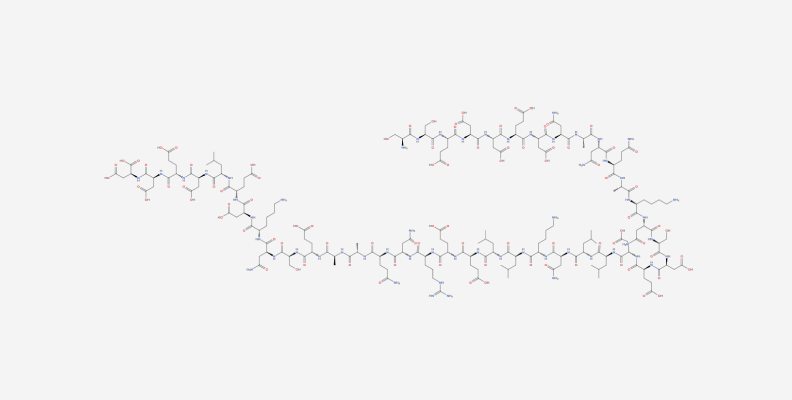
| Product Name | Thymosin Beta 4 |
| Synonyms | Tβ4, Thymosin β4 |
| CAS Number | 77591-33-4 |
| Sequence (3-Letter) | Ac-Ser-Asp-Lys-Pro-Asp-Met-Ala-Glu-Ile-Glu-Lys-Phe-Asp-Lys-Ser-Lys-Leu-Lys-Lys-Thr-Glu-Thr-Gln-Glu-Lys-Asn-Pro-Leu-Pro-Ser-Lys-Glu-Thr-Ile-Glu-Gln-Glu-Lys-Gln-Ala-Gly-Glu-Ser-OH (N-terminal acetylation) |
| Sequence (1-Letter) | Ac-SDKPDMAEIEKFDKSKLKKTETQEKNPLPSKETIEQEKQAGES (43 residues) |
| Molecular Formula | C₂₁₂H₃₅₀N₅₆O₇₈S |
| Molecular Weight | 4963.4 |
| Category | Drug Peptide – Actin-Sequestering Peptide (β-Thymosin) |
| Purity | ≥98% (by HPLC) |
| Appearance | White to off-white lyophilized powder |
| Counter Ion | Acetate (salt form per specification) |
| Peptide Content | ≥80% (per specification) |
| Solubility | Soluble in water |
| Storage | -20°C, desiccated, protected from light |
| Available Scale | mg – kg (research quantities to scale-up batches) |
| QC Documentation | COA, HPLC, MS identity (additional API/regulatory documentation on request) |
| Usage | For research and pharmaceutical development use, and as a reference standard or active pharmaceutical ingredient for manufacturing. Not for human or veterinary use; not for sale to patients. Any therapeutic use is subject to applicable regulatory approval. |
Thymosin beta-4, often written T-beta-four, is a natural forty-three-amino-acid peptide found in most tissues (CAS 77591-33-4). Its sequence is Ac-SDKPDMAEIEKFDKSKLKKTETQEKNPLPSKETIEQEKQAGES, an acetylated chain with no cysteines and no disulfide bonds. It is the most abundant member of the beta-thymosin family and the main peptide that binds and stores actin inside cells. We supply it as a white powder for research and pharmaceutical development.
Thymosin beta-four works mainly by binding actin. It grabs single actin molecules, known as G-actin, one to one and keeps them from joining into filaments, which lets cells control their internal skeleton. Outside the cell, research links it to processes such as new blood-vessel formation, tissue repair, and the calming of inflammation, with a short actin-binding motif in the sequence playing a central part.
Thymosin beta-four is studied in research for its roles in actin regulation, new blood-vessel formation, tissue repair, and inflammation, including work in models of heart and eye injury. These are research findings only; the material we supply is for research and pharmaceutical manufacturing use, and is not for human or veterinary use and not for sale to patients, and we make no health or treatment claims.
We supply Thymosin Beta 4 with a certificate of analysis, HPLC purity data, and mass-spec identity confirmation. Additional documentation for API and regulatory work is available on request, and salt form and purity can be set to your specification.
Yes. We manufacture Thymosin Beta 4 in-house and supply from research quantities up to scale-up batches. As a forty-three-residue peptide it is a demanding synthesis, and we can discuss the right approach for your scale. Contact us with your required purity and quantity for a quote.
Thymosin beta-4 (T-beta-four) is a natural forty-three-amino-acid peptide and the main actin-sequestering peptide inside cells. It is the most abundant member of the beta-thymosin family and is widely used as a research peptide. We supply it as a raw material for research and pharmaceutical development.
Thymosin beta-4 is a forty-three-residue peptide, Ac-SDKPDMAEIEKFDKSKLKKTETQEKNPLPSKETIEQEKQAGES, with an acetyl group on its N-terminal serine and no cysteine residues, so it forms no disulfide bonds and has a simple, intrinsically disordered linear structure. A short conserved motif, LKKTET, beginning around residue seventeen, is central to its binding of actin. Its CAS number is 77591-33-4, its molecular formula is C212H350N56O78S, and its molecular weight is about 4963.
The best-defined role of thymosin beta-4 is binding actin. It binds single G-actin molecules in a one-to-one ratio and prevents them from polymerising into actin filaments, helping cells regulate their cytoskeleton during processes such as movement and division. In research outside the cell it has also been associated with new blood-vessel formation, tissue repair, and the regulation of inflammation.
Thymosin beta-4 is studied in research for its roles in actin regulation, angiogenesis, tissue repair, and inflammation, including in models of heart and corneal injury. These are research findings only and are described here as scientific background. The material supplied by SynPeptide is intended for research and pharmaceutical manufacturing, is not for human or veterinary use, and is not for sale to patients; we make no health, performance, or treatment claims, and any therapeutic use would be subject to applicable regulatory approval.
We supply Thymosin Beta 4 with a certificate of analysis, HPLC purity data, and mass-spectrometry identity confirmation, with further documentation available to support active pharmaceutical ingredient and regulatory work. Purity and counter-ion can be set to your specification for use as a reference standard or in process development.
We manufacture Thymosin Beta 4 by solid-phase synthesis, including the N-terminal acetylation, and supply it from research quantities through to scale-up batches. As a long forty-three-residue peptide it benefits from established large-scale methods. For related capabilities, see drug peptides, custom peptide synthesis, peptide modification, and large-scale peptide synthesis. Material is supplied for research and pharmaceutical manufacturing use only.


