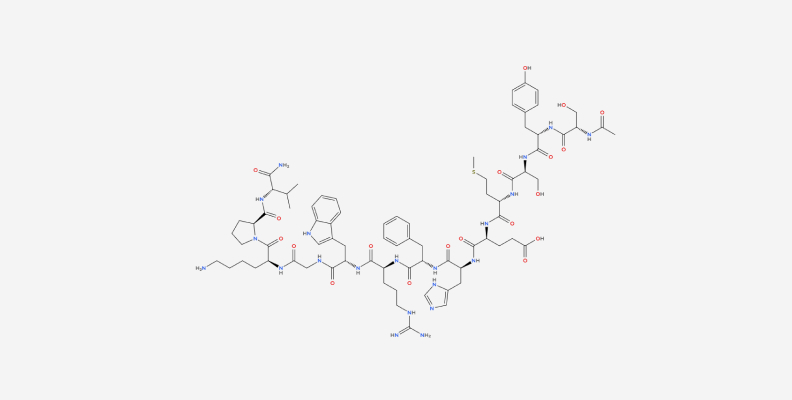
| Product Name | α-MSH, amide |
| Synonyms | alpha-Melanocyte-Stimulating Hormone; α-Melanotropin; Acetyl-ACTH (1-13) amide; α-Intermedin (human, porcine, bovine, rat, mouse) |
| CAS Number | 581-05-5 |
| Sequence (3-Letter) | Ac-Ser-Tyr-Ser-Met-Glu-His-Phe-Arg-Trp-Gly-Lys-Pro-Val-NH2 |
| Sequence (1-Letter) | Ac-SYSMEHFRWGKPV-NH2 (13 residues; N-terminal acetylation, C-terminal amide) |
| Molecular Formula | C₇₇H₁₀₉N₂₁O₁₉S |
| Molecular Weight | 1664.9 |
| Category | Drug Peptide – α-MSH (Melanocortin Receptor Agonist) |
| Purity | ≥98% (by HPLC) |
| Appearance | White to off-white lyophilized powder |
| Counter Ion | Acetate (salt form per specification) |
| Peptide Content | ≥80% (per specification) |
| Solubility | Soluble in water |
| Storage | -20°C, desiccated, protected from light |
| Available Scale | mg – g (research quantities; larger scale on enquiry) |
| QC Documentation | COA, HPLC, MS identity (additional API/regulatory documentation on request) |
| Usage | For research and pharmaceutical development use, and as a reference standard or active pharmaceutical ingredient for manufacturing. Not for human or veterinary use; not for sale to patients. Any therapeutic use is subject to applicable regulatory approval. |
Alpha-MSH (alpha-melanocyte-stimulating hormone), amide, is a natural thirteen-residue peptide hormone of the melanocortin family (CAS 581-05-5). Its sequence is Ac-SYSMEHFRWGKPV-NH2, the first thirteen residues of ACTH with an acetyl group at the start and an amide at the end; both of these modifications are needed for full activity. It has no cysteines and no disulfide bonds. We supply it as a white powder for research and pharmaceutical development.
Alpha-MSH works by activating melanocortin receptors, a family of G-protein-coupled receptors. It is a non-selective agonist at four of them, MC-one, MC-three, MC-four, and MC-five, but not the ACTH-specific MC-two receptor. Activating these receptors raises cyclic AMP inside cells. A short four-residue core in the middle of the sequence, His-Phe-Arg-Trp, is the part that the receptors recognise.
Alpha-MSH is studied in research for its roles in skin and hair pigmentation through the MC-one receptor, in appetite and energy balance through the MC-four receptor, and in inflammation, where it lowers several pro-inflammatory signals. These are research findings only; the material we supply is for research and pharmaceutical manufacturing use, and is not for human or veterinary use and not for sale to patients, and we make no health, cosmetic, or performance claims.
We supply alpha-MSH with a certificate of analysis, HPLC purity data, and mass-spec identity confirmation. Additional documentation for API and regulatory work is available on request, and salt form and purity can be set to your specification.
Yes. We manufacture alpha-MSH in-house and supply from research quantities up to larger batches. Contact us with your required purity, salt form, and quantity for a quote.
Alpha-MSH (alpha-melanocyte-stimulating hormone), amide, is a natural thirteen-residue peptide hormone of the melanocortin family and a non-selective melanocortin receptor agonist. It is widely used as a research peptide, and we supply it as a raw material for research and pharmaceutical development.
Alpha-MSH is a tridecapeptide, Ac-SYSMEHFRWGKPV-NH2, corresponding to the first thirteen residues of ACTH with two post-translational modifications: an acetyl group on the N-terminal serine and an amide on the C-terminal valine. Both modifications increase potency and stability and are needed for full activity. It is derived from pro-opiomelanocortin (POMC) and contains no cysteine residues and no disulfide bonds. A conserved four-residue core, His-Phe-Arg-Trp, is the receptor-recognition motif shared across melanocortin peptides. Its CAS number is 581-05-5, its molecular formula is C77H109N21O19S, and its molecular weight is about 1665.
Alpha-MSH activates melanocortin receptors, which are G-protein-coupled receptors that signal through cyclic AMP. It is a non-selective full agonist at MC1, MC3, MC4, and MC5, with highest affinity for MC1, but it does not act at the ACTH-specific MC2 receptor. Activation of MC1 underlies its role in pigmentation, while MC4 mediates its effects on appetite and energy balance.
Alpha-MSH is studied in research on skin and hair pigmentation, appetite and energy homeostasis, and inflammation, where it reduces several pro-inflammatory signals. Several more potent synthetic analogues of alpha-MSH have separately been developed as medicinal drugs. These are research findings and background information only; the material supplied by SynPeptide is intended for research and pharmaceutical manufacturing, is not for human or veterinary use, and is not for sale to patients, and we make no health, cosmetic, or performance claims.
Alpha-MSH is the acetylated, amidated form of the first thirteen residues of ACTH, so it shares its N-terminal sequence and the His-Phe-Arg-Trp core with ACTH fragments such as ACTH (1-10). The shared core is why both bind melanocortin receptors, although alpha-MSH, unlike ACTH, does not act at the adrenal MC2 receptor.
We manufacture alpha-MSH by solid-phase synthesis, including the N-terminal acetylation and C-terminal amide, and supply it with a certificate of analysis, HPLC purity data, and mass-spectrometry identity confirmation, with purity and salt form set to your specification. We supply from research quantities through to larger batches. For related services, see drug peptides, custom peptide synthesis, and peptide modification. Material is supplied for research and pharmaceutical manufacturing use only.


