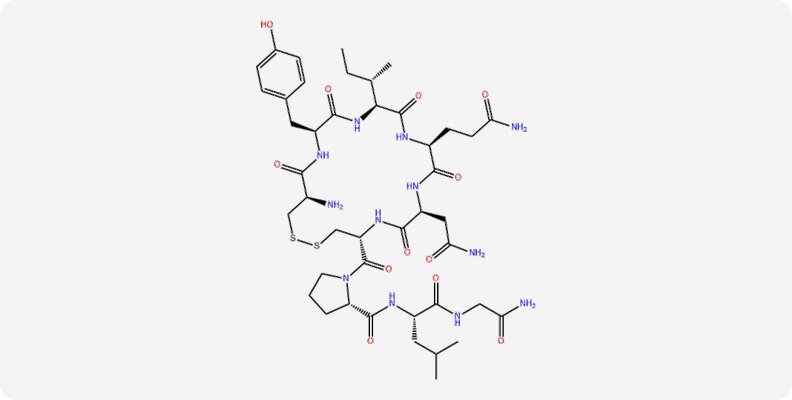
| Product Name | Oxytocin Acetate |
| Synonyms | Oxytocin, α-Hypophamine, Pitocin, Syntocinon |
| CAS Number | 50-56-6 |
| Sequence (3-Letter) | Cys-Tyr-Ile-Gln-Asn-Cys-Pro-Leu-Gly-NH₂ [Disulfide: Cys1-Cys6] |
| Sequence (1-Letter) | CYIQNCPLG-NH₂ |
| Molecular Formula | C₄₃H₆₆N₁२O₁₂S₂ |
| Molecular Weight | 1007.19 |
| Category | Drug Peptide |
| Purity | ≥98% (by HPLC) |
| Appearance | White to off-white lyophilized powder |
| Counter Ion | Acetate (TFA-free available on request) |
| Peptide Content | ≥85% |
| Solubility | Soluble in water (1 mg/mL), acetic acid, ethanol (5 mg/mL), DMSO (14 mg/mL) |
| Storage | -20°C, desiccated, protected from light |
| Available Scale | mg – kg |
| QC Documentation | COA, HPLC, MS (included with every order) |
| Usage | For research and pharmaceutical applications only. Not for human consumption. |
Oxytocin Acetate is widely used in neuroscience, reproductive biology, and behavioral research. Common applications include studies on social bonding and attachment, uterine contraction mechanisms, lactation physiology, autism spectrum disorder models, stress response and HPA axis regulation, and pain modulation. It is also used as an API reference standard in pharmaceutical development. This product is for research and pharmaceutical use only — not for human consumption.
Oxytocin Acetate is soluble in water at concentrations up to 1 mg/mL. It is also soluble in ethanol (5 mg/mL) and DMSO (14 mg/mL). To dissolve, add solvent slowly along the vial wall and swirl gently — do not shake or vortex aggressively. Store the lyophilized powder at -20°C, desiccated and protected from light. Once reconstituted, keep the solution at 2–8°C and use within 2–4 weeks. For longer storage, aliquot and freeze at -20°C. Avoid repeated freeze-thaw cycles.
Oxytocin refers to the free base form of the peptide (CAS 50-56-6). Oxytocin Acetate (CAS 6233-83-6) is the acetate salt form, which is the most common commercial format. The peptide sequence is identical — the difference is the counter ion. Acetate salt offers better stability and easier handling compared to the TFA salt form. For most research applications, the two are interchangeable.
For general immunization, ELISA, and antibody production, >95% purity is sufficient. For in vivo studies, receptor binding assays, and quantitative bioassays, we recommend >98% purity. For pharmaceutical R&D and GMP-related work, >98% with extended QC documentation is available on request. Every batch from SynPeptide is verified by HPLC and MS.
Yes. We manufacture Oxytocin Acetate in-house and can supply quantities from milligrams to kilograms. Bulk pricing is available — contact us with your required quantity and purity for a custom quote. All orders include COA, HPLC, and MS documentation.
Oxytocin is a 9-amino acid cyclic peptide hormone produced by the hypothalamus and released from the posterior pituitary gland. Its structure features a disulfide bridge between Cys1 and Cys6, forming a six-residue ring with a three-residue C-terminal tail. This cyclic conformation is critical for receptor binding and distinguishes oxytocin from linear peptides of similar length.
Oxytocin acts on the oxytocin receptor (OXTR), a G-protein coupled receptor expressed in uterine smooth muscle, mammary tissue, and multiple brain regions. Its two best-characterized physiological roles are stimulation of uterine contractions during labor and milk ejection during lactation. Beyond reproductive function, oxytocin is involved in social recognition, pair bonding, anxiety regulation, and stress response through its modulation of the HPA axis.
Oxytocin Acetate is used across several research fields. In neuroscience, it serves as a tool compound for studying social behavior circuits, fear extinction, and amygdala-prefrontal connectivity. In reproductive biology, it is used in uterine contractility assays and lactation models. Autism spectrum disorder research has explored oxytocin administration as a means to improve social cognition, with clinical trials reporting mixed but ongoing results. It is also used in cardiovascular and renal research due to its mild natriuretic and vasodilatory effects.
Oxytocin and vasopressin (AVP) differ by only two amino acids — at positions 3 and 8. Despite this structural similarity, they activate distinct receptor systems and produce different physiological outcomes. However, cross-reactivity between oxytocin and vasopressin receptors (V1a, V1b, V2) is well documented, which is an important consideration when designing experiments that aim to isolate oxytocin-specific effects.
Synthetic oxytocin (marketed as Pitocin and Syntocinon) is FDA-approved for labor induction, labor augmentation, and postpartum hemorrhage prevention. In pharmaceutical development, Oxytocin Acetate serves as an API reference standard and is used in formulation studies, stability testing, and analytical method validation for peptide drug products.


