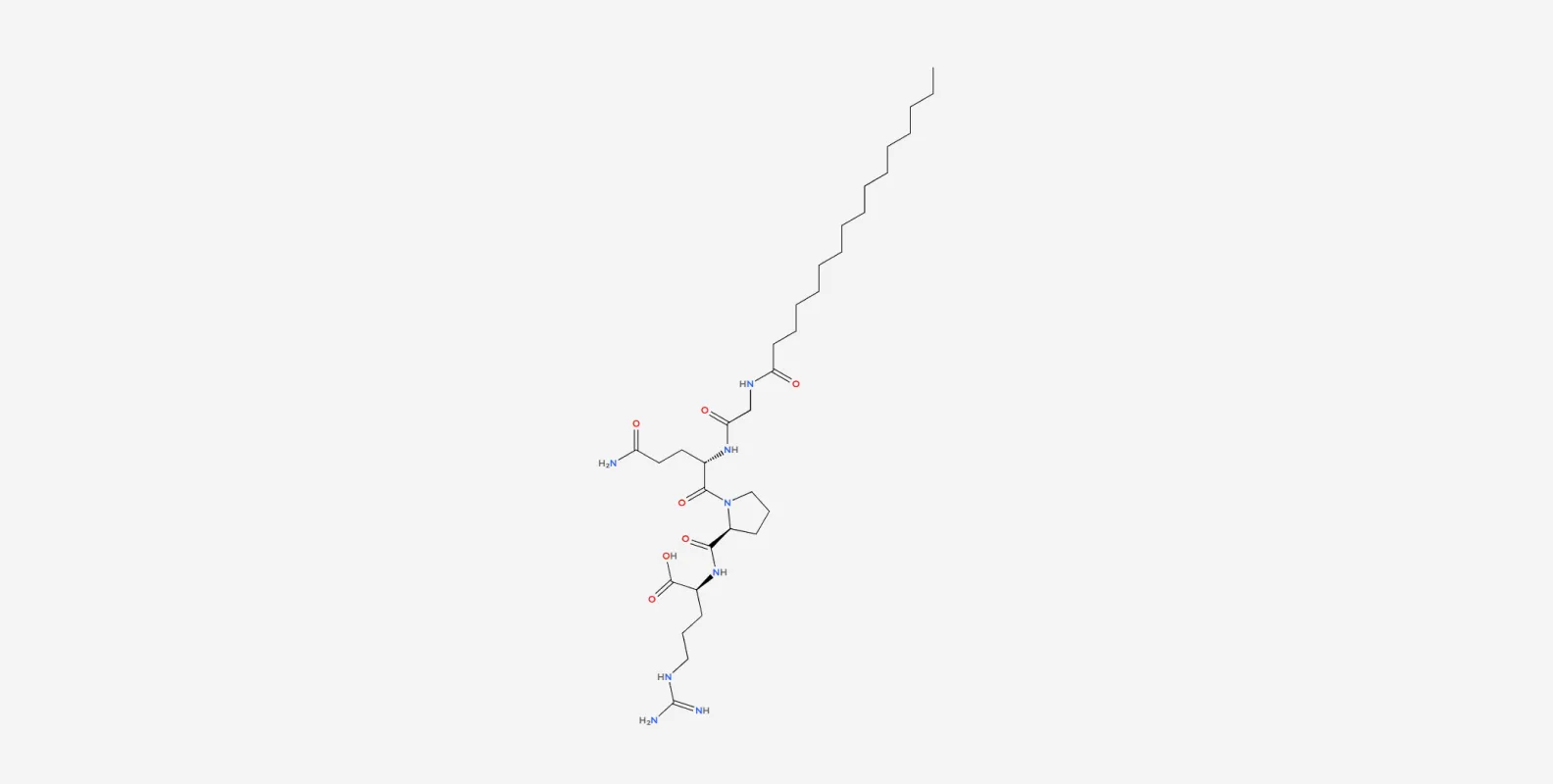
| Product Name | Palmitoyl Tetrapeptide-7 |
| Synonyms | Pal-GQPR, Rigin, N-Palmitoylrigin, Palmitoyl-Gly-Gln-Pro-Arg-OH |
| CAS Number | 221227-05-0 |
| Sequence (3-Letter) | Palmitoyl-Gly-Gln-Pro-Arg-OH |
| Sequence (1-Letter) | Pal-GQPR |
| Molecular Formula | C₃₄H₆₂N₈O₇ |
| Molecular Weight | 694.9 |
| Category | Cosmetic Peptide |
| Purity | ≥98% (by HPLC) |
| Appearance | White to off-white powder |
| Counter Ion | Free acid / acetate (TFA-free available on request) |
| Peptide Content | ≥90% |
| Solubility | Soluble in DMSO and warm ethanol; limited aqueous solubility (commonly used pre-dissolved or in liposomal or glycol formulations) |
| Storage | -20°C, desiccated, protected from light |
| Available Scale | mg – kg |
| QC Documentation | COA, HPLC, MS (included with every order) |
| Usage | For cosmetic formulation and research use only. Supplied as a raw material; finished-product efficacy and safety claims are the formulator's responsibility. Not a drug; not for direct use without formulation. |
Palmitoyl Tetrapeptide-7 is a cosmetic anti-aging peptide, sequence Palmitoyl-Gly-Gln-Pro-Arg (Pal-GQPR), CAS 221227-05-0, originally known as Rigin. The GQPR sequence is a fragment of immunoglobulin G, capped with palmitic acid to improve skin penetration. It is supplied as a white powder for skincare and research.
It is used as an anti-aging, soothing ingredient. Suppliers describe it as helping to calm the signs of aging linked to skin inflammation and to protect the skin's matrix, supporting a firmer, smoother look. It is best known as part of the Matrixyl 3000 peptide pair. Any efficacy claim on a finished product is the formulator's responsibility.
As skin ages, low-grade inflammation contributes to the breakdown of collagen and the skin matrix. Palmitoyl Tetrapeptide-7 is reported to suppress the inflammatory signal interleukin-6 and to limit matrix-degrading enzymes and glycation, which is the rationale for using it to help protect the look of firm, youthful skin. The palmitic acid cap aids skin penetration. This is a cosmetic effect on the appearance of skin.
The two peptides play complementary roles. Palmitoyl Oligopeptide, in its Pal-GHK form, is associated with supporting collagen production, while Palmitoyl Tetrapeptide-7 is associated with protecting the matrix by calming inflammatory signals. Used together in Matrixyl 3000, they pair a building action with a protecting one.
Yes. We manufacture Palmitoyl Tetrapeptide-7 in-house and supply from milligrams to kilograms, with COA, HPLC, and MS included. Contact us with your required purity and quantity for a quote.
Palmitoyl Tetrapeptide-7 is a synthetic peptide used in anti-aging skincare to help protect the skin's support structure and calm the signs of aging tied to inflammation. It was originally developed as Rigin and is best known as one half of the Matrixyl 3000 peptide pair.
It is a lipopeptide with the sequence Palmitoyl-Gly-Gln-Pro-Arg (Pal-GQPR). The GQPR part is a fragment of the human immunoglobulin G heavy chain, and it is capped at the N-terminus with palmitic acid, a C16 fatty acid that improves skin penetration. Its CAS number is 221227-05-0, its molecular formula is C34H62N8O7, and its molecular weight is about 694.9.
One driver of skin aging is chronic low-grade inflammation, sometimes called inflammaging, which speeds up the breakdown of collagen and the extracellular matrix. Palmitoyl Tetrapeptide-7 is reported to suppress the pro-inflammatory signal interleukin-6 in skin cells, to reduce UV-induced inflammatory responses, and to limit matrix-degrading enzymes and glycation. In a cosmetic product this is the rationale for using it to help preserve the look of firm, smooth skin. The effect is on the appearance of the skin.
Palmitoyl Tetrapeptide-7 is most often used alongside Palmitoyl Oligopeptide in the well-known Matrixyl 3000 complex. The two peptides take complementary approaches: the GHK form of palmitoyl oligopeptide is linked to supporting collagen production, while Palmitoyl Tetrapeptide-7 is linked to protecting the matrix by calming inflammatory signals. Together they pair a building action with a protecting one, which is the idea behind the combination.
Palmitoyl Tetrapeptide-7 is used at trace levels and is handled as a standard cosmetic raw material. Supplier and published studies report improvement in the look of fine lines when it is used in combination formulas, but any claim on a finished product is the responsibility of the formulator, and finished products should be safety-assessed for their specific formula and use.
We manufacture Palmitoyl Tetrapeptide-7 by solid-phase synthesis, including the N-terminal palmitoylation, and supply it from milligram to kilogram scale with a COA, HPLC, and MS report. For related ingredients and the underlying chemistry, see cosmetic peptides, custom peptide synthesis, and peptide modification. This material is supplied for cosmetic formulation and research use and is not a drug.


